
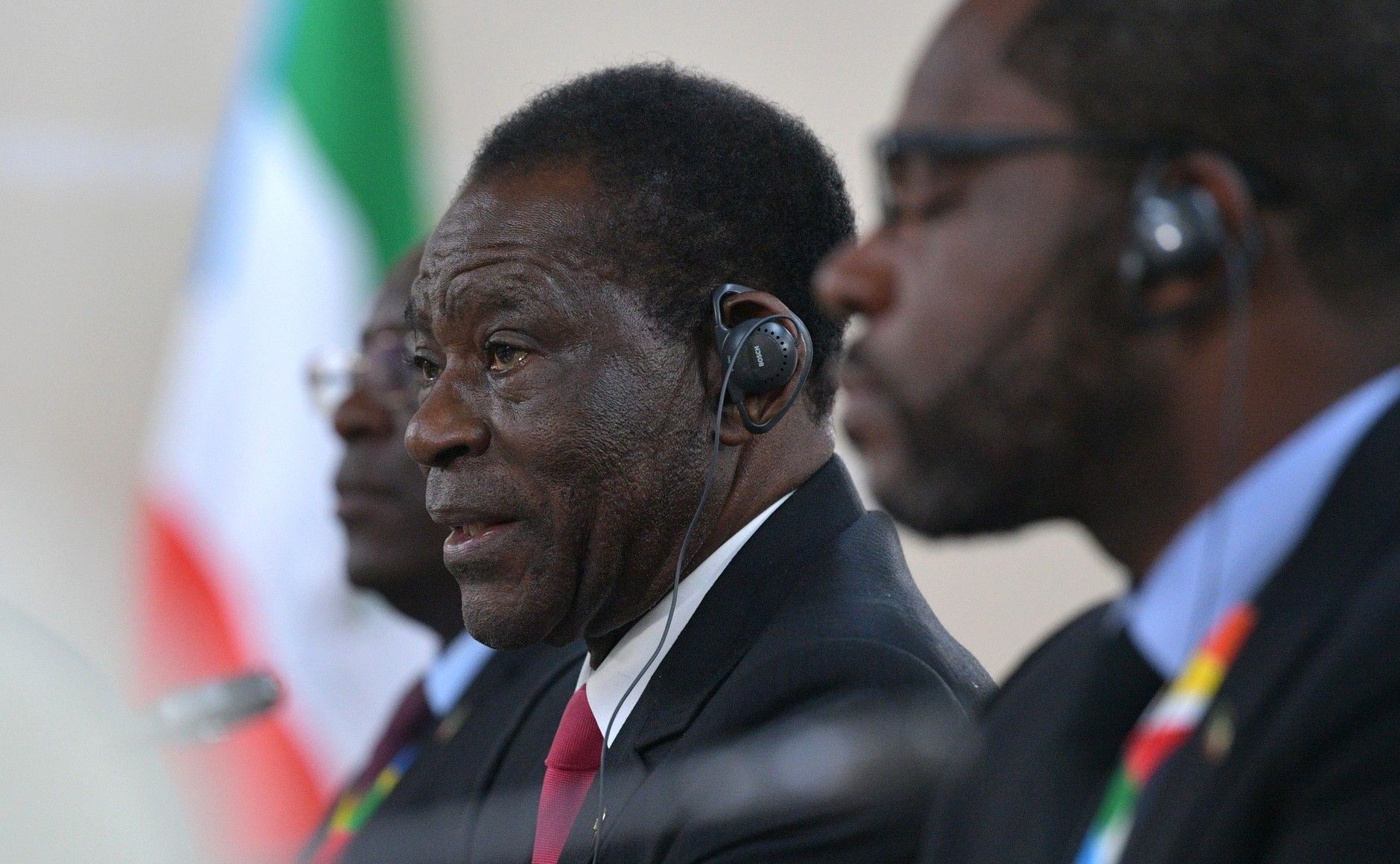
On the fourth and fifth floors of 42 avenue Foch in Paris, five diplomats from Equatorial Guinea still go to work, though a Paris court has ordered them out. French agents changed the locks and disabled the cameras in June 2025, but not up there, and AFP reported on October 13 that the upper floors have no running water or electricity, according to its English service. Malabo’s flag hangs from the roof of the mansion, which has more than 100 rooms. In September, buyers were walked through the first three floors, and one bidder was reportedly sent away by the military attaché, according to a person with knowledge of the case. French authorities want the sale signed by December 23. On October 19 Equatorial Guinea’s ambassador to the European Union, Miguel Oyono Ndong, told Africa Radio that even if the building is sold, “nos diplomates ne quitteront pas les lieux” (our diplomats will not leave the premises).
The man who once owned the house is Teodoro Nguema Obiang Mangue, known as Teodorin, the vice-president and the president’s eldest son. A French court convicted him of money laundering in 2017, and the confiscation became final in 2021. Under the constitution, as I read it, he takes over within 24 hours if his father dies or resigns. The fight over the building shows how far the country’s rulers are prepared to go to protect a family asset. The related question is whether anyone outside the government can check the family’s grip on the state. They cannot, because the government has chosen not to publish its senior officials’ asset declarations, which are lists of what they own, and because I could not find a public list of who holds each senior post. Without them, a reader cannot tell which prosecutions of relatives are accountability and which are rivalry.
Facebook and TikTok stopped working in Equatorial Guinea in September, after a young woman posted a video accusing the vice-president of corruption. AFP reported on September 16 that they had been unreachable without a VPN, a tool that hides where a user connects from, for more than two weeks, as the Jamaica Observer carried it. AFP says the block began on September 2 and the woman “was arrested by the authorities”; it gives no name, date or charge, and the information minister did not respond. The government gave no reason for the block, and I found no report that either platform works again or that the woman has been released. On September 17 the vice-president’s lawyer, Esperanza Nsue Ensema Mikue, announced a complaint for spreading false news against three influencers living in Spain and one journalist, an offence under the cybercrime law that carries six months to five years. AFP does not say whether the woman is among them.
This is the third country in First Families, a weekly series on which relatives of ruling families hold which posts, after Chad and Tanzania.
Who holds the posts
Teodoro Obiang Nguema Mbasogo took power in August 1979 in a coup against his uncle. He was re-elected in November 2022 with an official 94.9 percent of the vote, and the largest opposition party, the CPDS, called it mass fraud, Lusa reported. Teodorin has been vice-president since June 22, 2016, by a decree read on state television, AFP reported, and the Associated Press (AP) says he oversees national defence and security. In the reformed constitution I read, the president appoints and dismisses the vice-president, who must belong to his party, and if the president dies, resigns or can no longer serve, the vice-president serves the rest of the term with no election. This is my reading of the text, not a lawyer’s. The next presidential election is due in 2029, according to the Bertelsmann Foundation’s BTI 2026 report.
Other relatives have held posts too. Gabriel Obiang Lima, another son of the president, was Minister of Mines and Hydrocarbons until February 2023, when Africa Energy called his move an apparent downgrade, and Forbes Africa Lusofona says he was left out of the August 2024 government. I found no source that says what he does now. Carmelo Ovono Obiang is also a son of the president. AFP calls him head of the foreign intelligence service, but other sources call him only the president’s son, so I cannot confirm his post. Baltasar Ebang Engonga, the president’s nephew, according to AFP, headed ANIF, the national agency that tracks suspicious money, until he was dismissed in November 2024. In October 2018 AFP reported that the president gave top military posts to a brother-in-law, Victoriano Nsue Okomo, a cousin and a son-in-law. A man of that name kept the defence ministry in June 2026, but I found no source that says he is the same person. The security minister, Nicolás Obama Nchama, Isaac Nguema Ondo, whom El Español describes as deputy director general of presidential security, and the heads of the state oil and gas companies are not shown to be relatives. Sharing a surname is not proof, and I do not suggest it.
What courts abroad found
Holding a post as a relative is not evidence of wrongdoing, and no case below says it is. In France, a Paris court convicted Teodorin in October 2017 of laundering money from embezzled public funds, which means hiding where stolen public money came from. It gave him a three-year suspended sentence, which means no prison unless he is convicted again, and a suspended fine of €30 million. The conviction became final on July 28, 2021, with about €150 million of assets confiscated, according to Transparency International.
The Paris mansion is the last of those assets to be sold. French authorities published a notice of sale on June 26, 2026, the foreign ministry told the Senate. AFP reported on October 13 that firm offers were due on October 9, that the French agency for seized assets had received 15 applications, and that the sale must be signed by December 23 at the latest. It says the buyer may take the building with its occupants, at a possible big discount, and that a source fears a front bid by Teodorin himself. The price has not been disclosed. La Cinquième reported an estimate of about 100 million euros.
In the United States, Teodorin settled a civil forfeiture case in 2014 by giving up about $30 million in assets. In such a case, the government asks a court to take property it says was bought with illegal money. The Justice Department had alleged he collected more than $300 million on a salary under $100,000. I found no admission and no criminal case. On July 22, 2021, the UK put Teodorin under sanctions, which include freezing his assets, and its notice says he “is or has been responsible for or engaging in bribery and the misappropriation of property.” Teodorin has answered that anyone who accuses him of corruption must prove it in court and that his wealth came from private business, in an X post on or around August 30 reported by Forbes Africa Lusofona. I found no source that says a current appointment was made because of, or to protect anyone from, a corruption case. The one documented link between family office and state money is old: a 2004 US Senate staff report found that withdrawals from the government’s oil accounts at Riggs Bank needed two signatures, the president’s and either his son, then minister of mines, or his nephew, then secretary of state for the treasury and budget.
Arrests at home
At home, Ruslan Obiang Nsue, a son of the president, was arrested in January 2023, and Teodorin wrote that he had ordered his immediate arrest. He was convicted in August 2025 over the sale of a Ceiba aircraft, ch-aviation reported, and can avoid a six-year sentence by repaying about $225,000. Engonga was sentenced to eight years in August 2025 for taking public money, AFP reported. I found no source that links these cases to the appointment of relatives, and I do not claim a link.
On March 2, 2026, a Spanish judge moved to prosecute Carmelo Ovono Obiang, Nicolás Obama Nchama and Isaac Nguema Ondo over the 2019 abduction of four opposition members from South Sudan, citing “indications” of their involvement. No one has been convicted or detained. One of the four, Julio Obama Mefuman, died in January 2023, and the foreign minister said he died of an illness, Al Jazeera reported.
A military court sentenced the opposition leader Gabriel Nse Obiang Obono to 29 years in June 2023, after a September 2022 police raid on his party in which more than 150 people were arrested, according to Amnesty. In 2025 the UN Working Group on Arbitrary Detention, a panel of independent experts, found the detention of 37 residents of the island of Annobón arbitrary, which means not based on a lawful reason. They were pardoned in June 2025.
Analysts read all this differently, and their readings are judgments, not findings. BTI says most of the army, including its largest regiments in Bata, is controlled by Teodorin’s relatives on his mother’s side, and that Teodorin uses the anti-corruption campaign to look legitimate and push rivals aside. After Engonga’s dismissal, one activist told the BBC that Teodorin was removing anyone who could challenge his succession. The BBC called it a theory, and I found no proof.
Two gaps that hide each other
In July 2025 the International Monetary Fund (IMF) recorded that the authorities “decided not to publish asset declarations of public officials”, which meant missing two reform targets. A report on oil and gas revenue was due by the end of April 2026. The IMF said in February that work on it had begun, and I could not find that it was published.
The record has two gaps, and each hides the other. Officials file asset declarations with the anti-corruption commission, the IMF says, but the government decided not to publish them, so a reader cannot tell whether a relative’s post and wealth match. And I could not find the decrees for the 2024 or 2026 governments, or confirm the current posts of several relatives named in the press. The man the constitution makes the next president therefore sits at the top of a government whose senior posts cannot be checked against any official record. What the record does show is the state acting against the president’s relatives: a son was convicted, a nephew was sentenced, and the vice-president wrote that he ordered the arrest of another son. It also shows social media blocked after a video accusing him, and an analyst’s finding that the anti-corruption campaign is used to push rivals aside. With neither declarations nor a list of posts, a reader cannot tell which cases are accountability and which are rivalry. Outside governments deal with him on the same incomplete record: the United States eased travel limits on him in September 2025, AP reported, so that he could visit and meet a senior US diplomat.
Could this have gone differently? The government could have published the declarations and a list of posts, which would have cost it little. France could have told the story of the Paris building at the same time as the story of the rule that let it seize it. The strongest objection to publication is that where anti-corruption drives are used against rivals, published declarations could become a weapon rather than a safeguard, so keeping them private might protect people. That is a real risk. But it concerns who holds the declarations and how they are used. It says nothing against a public list of who holds each post, and without a public record his claim of private-business wealth cannot be checked either.
I am an independent investigative journalist with seven years of field research, and I hold an MA in International Law and Human Rights from the University for Peace (UPEACE). From 2019 to 2021 I was Somalia’s Youth Representative to the African Union, which Equatorial Guinea belongs to. I co-founded and chair the Organization for Prisoners’ Rights in Mogadishu, which I mention because this piece describes arrests. I have no financial or personal tie to the people or governments named here.
I do not know what Gabriel Obiang Lima and Carmelo Ovono Obiang do now, or who commands the army, police and customs. I do not know whether Gabriel Nse Obiang Obono is still detained, or whether the young woman was released or Facebook and TikTok work again. I do not know who chairs the anti-corruption commission: the International Consortium of Investigative Journalists says Teodorin presides, BTI says he did until November 2024, and the IMF lists another man, Tomás Esono Ava. I do not know whether the oil and gas transparency report was published, what the Paris mansion will sell for, or whether the government will answer the questions I sent it.
On the upper floors of avenue Foch, five diplomats are still at their desks without running water. Whether the family that sits behind them can be checked against any record is the question this series keeps asking, and the answer, so far, is no.
The rest of the series is on the series page.
Comments
Every comment is read by a person before it appears, so yours will not show straight away. We publish comments that are civil and on the subject. To report a mistake in the piece, use the corrections page, so it is fixed in the piece itself.