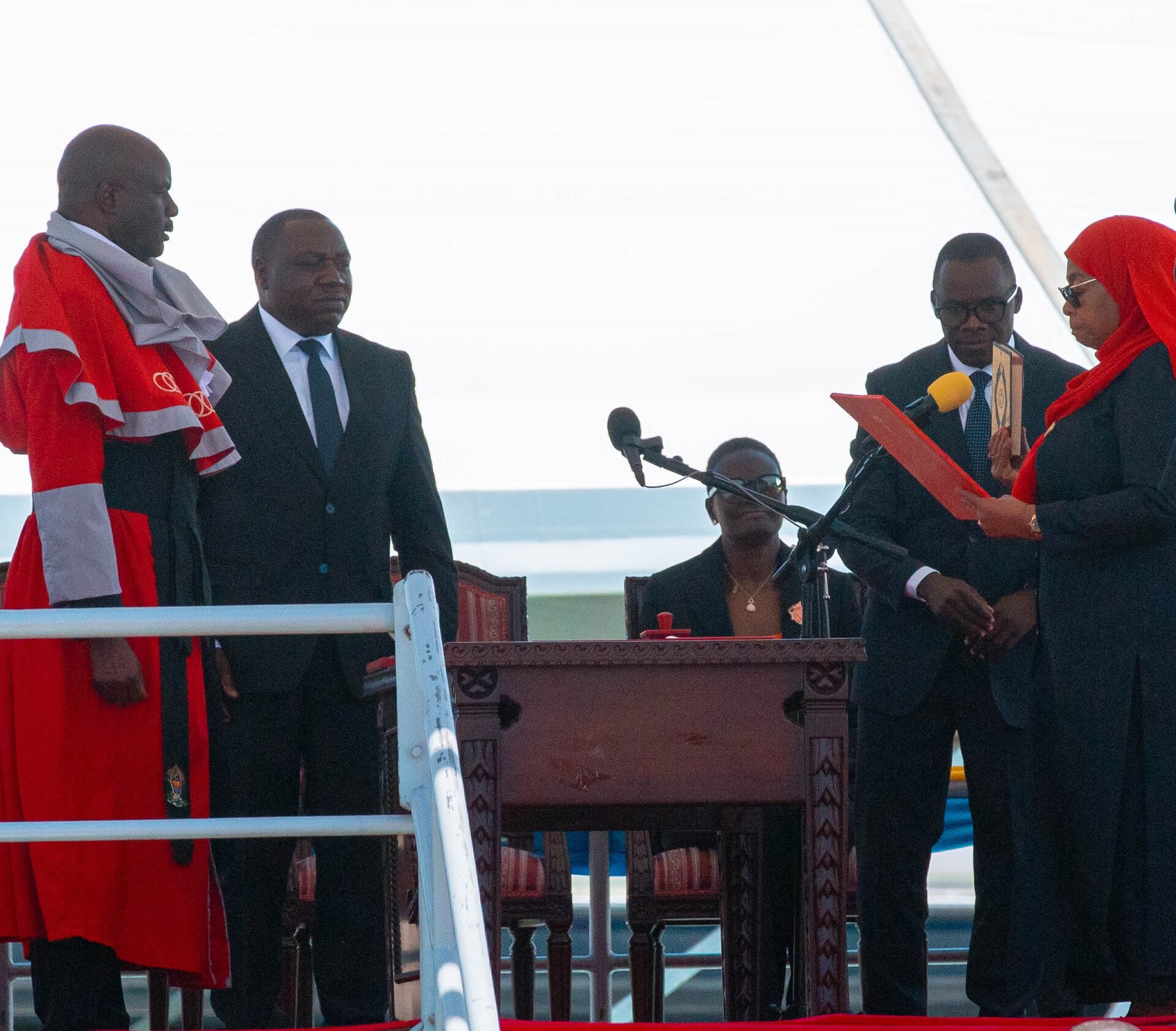
On November 17, 2025, President Samia Suluhu Hassan named a new cabinet from the State House in Chamwino, Dodoma: 27 ministers and 29 deputy ministers. It included her daughter, her daughter’s husband and the son of a former president. The government has not, as far as we found, said why those three were chosen. This is the first country in a weekly series, First Families, on which relatives of ruling families hold which posts.
The family file
- Wanu Hafidh Ameir, the president’s daughter. Named Deputy Minister of Education, Science and Technology. She is the member of parliament for Makunduchi, in Zanzibar, TRT Afrika reported.
- Mohamed Mchengerwa, the president’s son-in-law, married to Wanu. Named Minister of Health. He was already in government: he had been the minister for local government and regional administration, Nation Africa reported, and Pulse says he has held several cabinet posts under Samia and has been the member of parliament for Rufiji since 2015. We could not find when he and Wanu married, or whether the marriage came before or after his first cabinet post. His move to health was a change of ministry, not an entry into government.
- Ridhiwani Kikwete, son of former president Jakaya Kikwete. Promoted from deputy minister to full minister for Public Service Management and Good Governance, in the president’s office. He represents Chalinze. The Star reports that his father is credited with helping bring Samia to the party leadership and the presidency.
- Hussein Mwinyi, president of Zanzibar since 2020. He is the son of Ali Hassan Mwinyi, Tanzania’s second president, and was earlier Tanzania’s defence minister. Samia did not appoint him. He is part of the wider pattern of political families.
We found no official record of a relative of the president serving in the army, the police or the intelligence service. The public record we found concerns the cabinet and the palace, not the barracks.
What critics and supporters say
Critics, including opposition figures, call the appointments nepotism, Eastleigh Voice and Pulse reported. A Nation Africa opinion column argued that no Tanzanian president has placed both a child and a child’s spouse at the centre of government before. The same column recorded the supporters’ argument: that both Wanu and Mchengerwa are experienced, a lawyer and a former minister. We found no statement from the government answering either side.
A cabinet in constant motion
Samia has reshuffled her government often. By August 2024 it was the fourteenth change since March 2021, The Chanzo counted. In January 2022 she dropped four ministers and a deputy, saying she would remove those with their eyes on the 2025 election. Two of them, Palamagamba Kabudi and William Lukuvi, returned in August 2024. After the 2025 election she named Mwigulu Nchemba prime minister on November 13 and the new cabinet on November 17, dropping seven ministers, including Deputy Prime Minister Dotto Biteko, and keeping, Nation Africa said, the nucleus of her previous team. Against that record, the family appointments are one part of a government that changes often, and the question we could not answer is why these three roles were chosen.
The election that came before
The cabinet was named after the October 29 election, in which Samia was declared the winner with nearly 98 percent of the vote. Chatham House’s Fergus Kell pointed out that the announced turnout of nearly 33 million compares with a voting-age population of about 35 million. The main opposition party, Chadema, had been disqualified in April for failing to sign a code of conduct, its leader Tundu Lissu was in jail on treason charges he denies, and a second candidate was disqualified, GlobalSecurity records.
African Union observers concluded the election did not comply with AU standards, pointing to ballot stuffing, an internet blackout, allegations of excessive military force and politically motivated abductions. SADC said voters could not express their democratic will.
The president’s own inquiry, led by former Chief Justice Mohamed Chande Othman, reported in April 2026 that 518 people died in the violence, 502 civilians and 16 security personnel, and said the toll might not be final. It said the violence was planned and coordinated, could not confirm reports of mass graves, and recommended a criminal investigation commission. Kell noted that the commission’s members include the immediate former defence minister. The full report has not been published. The government accepted the recommendation. A new commission led by retired Court of Appeal judge Shaban Lila, with retired High Court judges as members, was launched at State House on August 7 with 150 days to report, which points to early January 2027 unless it is extended. Civil society groups and opposition leaders criticised the plan when it was announced in May, and Chadema continues to call for an independent international inquiry. The opposition rejected it as a cover-up and says thousands were killed, and Western diplomats gave estimates of between 1,000 and 2,000. Human Rights Watch said the commission did not assess whether the security forces’ conduct was lawful. Early on, the government denied that excessive force had been used. Seventeen diplomatic missions later cited credible evidence that bodies were concealed. No source we found links the family appointments to the way the vote was run.
The corruption record
In March 2026, the Controller and Auditor General and the anti-corruption bureau gave President Samia their reports for 2024/25. The auditor general found most institutions comply with reporting standards, but gave the state electrical and mechanical agency TEMESA an adverse opinion over Sh5.01 billion in payments involving ghost suppliers. The anti-corruption bureau found irregularities in 913 of 1,864 projects it reviewed. The auditor general is appointed by the president. No source we found ties these findings, or any corruption allegation, to the three relatives.
What analysts say it could mean
These are analysts’ judgments, not findings, and we make no predictions of our own.
Fergus Kell, a research fellow at Chatham House, wrote in December 2025 that adding her daughter and reappointing her son-in-law, together with discarding several high-profile ministers, suggests confidence that rivals inside the ruling party are “unwilling or unable to mount a threat of their own.” He noted that no party official has broken ranks to criticise the violence, and he warned that the government’s deflection of blame risks more instability. He also pointed out that the European Union was debating a freeze on development aid, while the two largest investments agreed for Samia’s new term, a Chinese railway refurbishment and a Russian uranium project, come from partners he said were unlikely to be deterred by governance concerns. The Africa Center for Strategic Studies said the government’s handling of the election has left the country on “highly unstable footing.”
The government rejects that framing. Officials have blamed foreign actors for influencing the protests and have called critical media reports “information warfare”, The Chanzo reported.
What we do not know
- Why these three were chosen, and what criteria the president used.
- Whether the president, her office or the ruling party will answer the criticism.
- What the full inquiry report says, what the criminal commission will find when it reports, and the independent death toll.
- Whether other relatives of the president hold posts we have not found.