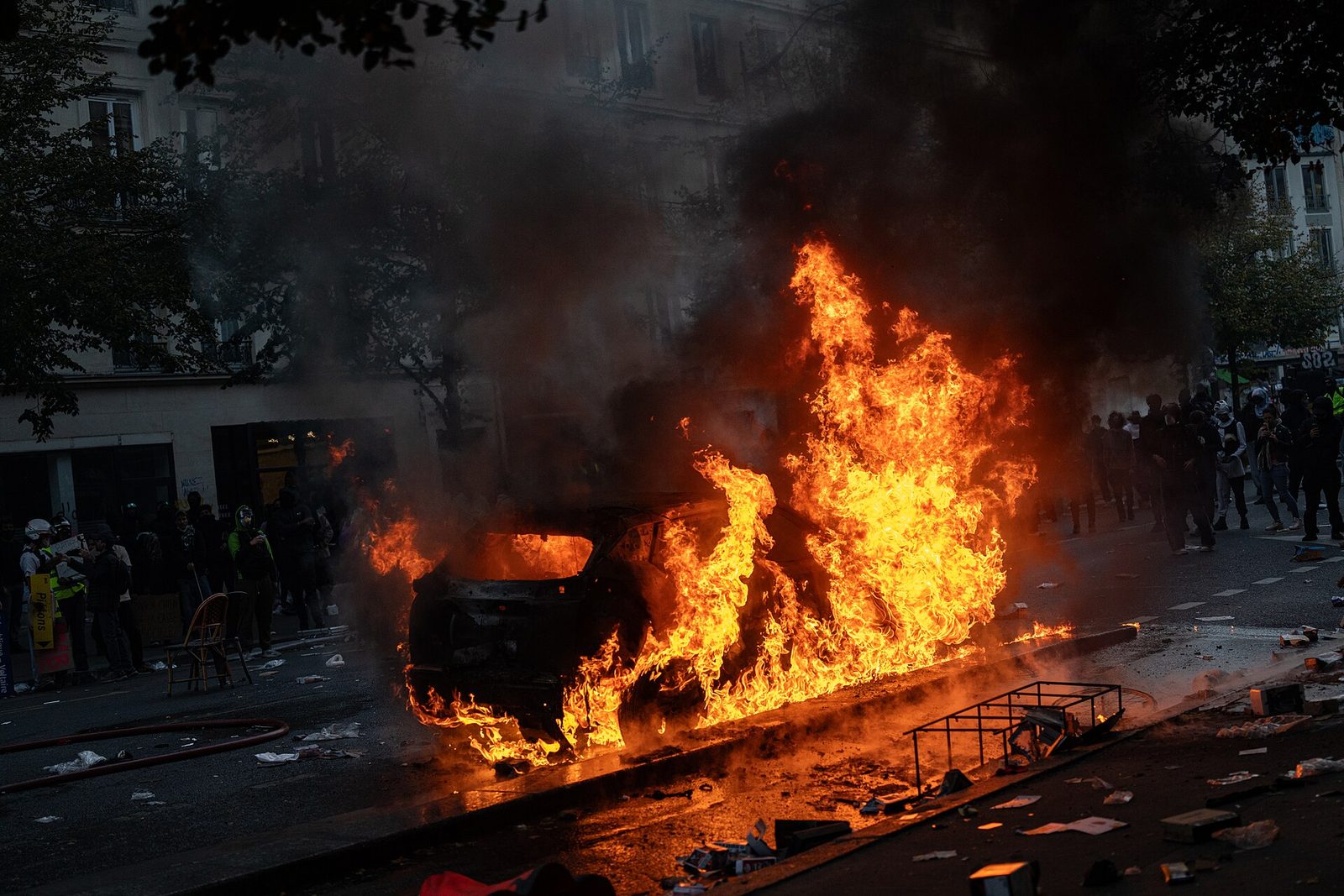
Limoges, Saturday, October 17. About 5,000 people had marched through the central French city against the cost of living, and authorities said several hundred of them were violent radicals. The mayor, Guillaume Guérin, said that by 3:30 p.m. the national police holding them on the boulevards had run out of crowd-control grenades and pulled back, AFP reported. That is his account, and the prefect rejected criticism of the police. Some of the rioters reached the town hall, broke windows and forced a door, and fires were set inside. Elected officials, municipal police and staff were in the building. Nobody was hurt. By evening hundreds of people stood watching it burn, and a town hall employee wept in the arms of an elected official. The belfry fell. The roof came down, and the prefect, Maurice Barate, said two thirds of the façade was gone, AFP reported. The building had been inaugurated in 1883. “Ce n’est pas de la bêtise, c’est de la haine,” Guérin said as the wind pushed the fire on: it is not stupidity, it is hatred.
That night was not an accident of one city. Across France that Saturday the interior ministry counted about 550,000 marchers, i24NEWS reported; the CGT union and other organizers said 800,000. Cars burned in Paris, a tourist office burned in Lyon, and protesters pushed into the lobby of Marseille’s City Hall. A week later the ministry’s own comparison, reported by AFP, put October 17 at 2,628 people detained and 1,144 injured among police, gendarmes and firefighters. Those are provisional government figures, not an independent count.
France spent that week answering the fire and not the reason for the march. The state restored order, and the second Saturday suggests it can. But the thing that put people on the streets, prices and a budget of cuts, is still in front of an Assembly that cannot agree on it, and the government has no majority to settle it. Order bought without an answer is borrowed time.
Where it started
It started in the schools, not in the streets. In mid-September students at a high school in Créteil, near Paris, began blockading it over crumbling buildings, crowded timetables, big classes, too few teachers and classrooms that overheat, Euronews reported, citing AFP. The blockades spread. The Associated Press counted thousands of arrests and hundreds of injuries since they began, and said some teenagers were badly hurt, with the injuries blamed on police crowd-control weapons, though it did not confirm the cause in each case. A teenager lost a hand in Lens in early October, and France suspended the use of police stun grenades at student protests, Euronews reported. On October 17 a 17-year-old lost his hand in Saint-Étienne, and both police and gendarmerie inspectorates were asked to investigate; Nuñez said he could not confirm it was a gendarmerie grenade.
Then adults joined. Calls on social media to revive the yellow-vest movement, which began in 2018 over diesel prices and is named after the high-visibility vests its members wore, met the CGT’s call for higher wages and pensions, lower prices and protection for public services, CBS News reported. Prices gave them a reason. Inflation hit 3.1% in September, up from 2.4% in August and the highest since January 2024, Trading Economics reported, with energy up 21.3% over the year. Far-left leader Jean-Luc Mélenchon, who is running in next spring’s presidential election, marched in Paris and urged protesters not to loot.
What the state did
The government’s first answer was to say the policing had failed. On October 19 Interior Minister Laurent Nuñez said the state had not anticipated the violence and offered his resignation. President Emmanuel Macron refused it, LCP reported. Justice Minister Gérald Darmanin told deputies that 2,513 people had been placed in custody, that more than 70 were already in pre-trial detention and that about 580 were due in court for fast trials, LCP reported. In a televised address on October 18 Macron said “Ceux qui ont détruit doivent payer” (those who destroyed must pay), according to LCP, and said demonstrations might be tightly supervised or even banned.
Then he acted on it. After a security meeting on October 22, Macron said only union-organised marches would be allowed on Saturday, October 24, and called for “the greatest firmness” against far-left groups, Sud Radio reported. About 70,000 police and gendarmes were deployed. The ministry counted 410,000 marchers nationwide, 110,000 in Paris, against 550,000 a week before. At about 7:30 p.m. some 500 rioters clashed with gendarmes at Porte de Vincennes in Paris, and tension went on late in Marseille, Lyon and Nice, according to Sud Radio’s live coverage. The provisional ministry count was 1,314 detained, 53 officers hurt and 24 shops looted, against the thousands the week before.
The Limoges inquiry moved too. Both suspects, aged 34 and 66, were placed under formal investigation and in pretrial detention on October 24, Sud Radio reported. The charges mentioned are attempted murder of a person holding public authority and destruction by dangerous means by an organised group. That report does not mention terrorism, although the anti-terror police directorate joined the inquiry earlier, AFP reported on October 20. The earlier suspect was reported to be on a security-service watchlist for far-left links.
So the state’s order was real, and it came from a ban, a mass deployment and a fast court process. The cost is that the opposition and the left saw it as a response to the riot and not to the march. Green leader Marine Tondelier left Matignon, the prime minister’s office, saying “On sort avec beaucoup de colère” (we leave with a lot of anger), after a meeting that dealt only with public order. And Nuñez has already said he expects October 31, when a new yellow-vest day is called, to be difficult again, with a “robust” security plan, according to LCP’s front page. Unions have called for a national strike on November 5.
The bill behind the march
The march was about money, and the money is in the budget. Prime Minister Sébastien Lecornu says the 2027 budget needs about €54 billion in savings, Euronews reported. It freezes public-sector pay, limits pension increases and changes state-paid sick leave. Lecornu says that without the cuts the yearly gap between spending and income would come close to 6.5% of economic output in 2027. France owes a record 119% of what it produces in a year, Fortune reported, and on October 2 the extra interest investors demand from France over Germany was the highest since the euro debt crisis of the early 2010s, Axios reported.
The Assembly has not delivered. The Tuesday, October 20 vote on the tax and income part of the state budget did not happen: about 2,830 of 3,396 amendments were still unexamined, LCP reported. Deputies moved to the Social Security budget, and on October 23 the Assembly rejected it almost unanimously; the revenue section failed 115 to 1, with the governing centre mostly abstaining, Sud Radio reported. The Senate takes the government’s original text on November 9. Debate on the state budget resumes on October 27, with the solemn vote on November 3, Journal du Net reported. It says amendments adopted so far would worsen the deficit by about €10 billion, a figure it attributes to the budget minister, David Amiel, and that Lecornu says a compromise is still possible in December. The vote on the full budget is set for November 17.
Sud Radio says the government is expected to use Article 49.3, which pushes a text through without a vote, or ordinances, in the coming weeks. If it does, Reuters notes, opponents can call a no-confidence vote, and if it passed the government would fall. Mujtaba Rahman of Eurasia Group wrote that France is “on the brink,” and warned that if the budget fails, debt payments could balloon. That is one analyst’s warning, not a forecast from the government or lenders. Gianluca Benigno of the University of Lausanne told Axios that “political paralysis is the trigger”, and Axios says the government is largely stuck until next year’s presidential election, in which Marine Le Pen leads the polls.
Could it have gone differently?
Two decisions look different in hindsight. The first is policing. The interior minister himself said the state had not anticipated the violence. A week later it deployed 70,000 officers and the violence was smaller, which suggests the means existed, and the mayor of Limoges says the means ran out there. We cannot say whether a bigger force would have saved the town hall, since the prefect disputes the mayor, and the inquiry has not finished.
The second is the budget calendar. The Assembly could not finish the amendments before the vote that was meant to fall three days after the biggest protest in years, and the government is now expected to push the text through without a vote. Had the government shown a path to a compromise before October 17, the marchers would still have marched, but the argument that the political system was not listening would have been harder to make. That is a judgment, not a finding.
Was the firm response right? On the evidence of the week, it worked on the street. It did not change the vote count or the prices. The question is whether a government that wins a Saturday has also won the Tuesday vote.
The strongest objection
The objection is that the protests were not about the budget at all. The fire in Limoges was set by a few people, two of them now in detention, and the ministry’s own count of 410,000 peaceful marchers a week later shows most protesters rejected it. On that view, treating the violence as part of a larger political failure excuses arson. I do not excuse it, and the courts will deal with the suspects. But the people who chose to march were reacting to the same prices and the same stalled budget, and the government’s own premise is that those pressures are real.
What we do not know
We do not know how many of the roughly 2,600 people detained on October 17 will be charged, or how the ministry’s injury counts split between police, gendarmes and firefighters. We do not know what happened to the Saint-Étienne teenager’s grenade, or whether the Limoges inquiry will find a link between the two suspects and any organised group. We could not confirm the exact hour the Limoges fire began. We do not know how the Assembly will vote on November 3, whether the government will use Article 49.3, or whether the October 31 and November 5 actions will bring the numbers of October 17 back.
On the evening of October 17 the crowd in Limoges watched the roof come down on a building from 1883. A week later the people who set it on fire were in detention, and the budget they marched against was still waiting for a vote.

Comments
Every comment is read by a person before it appears, so yours will not show straight away. We publish comments that are civil and on the subject. To report a mistake in the piece, use the corrections page, so it is fixed in the piece itself.