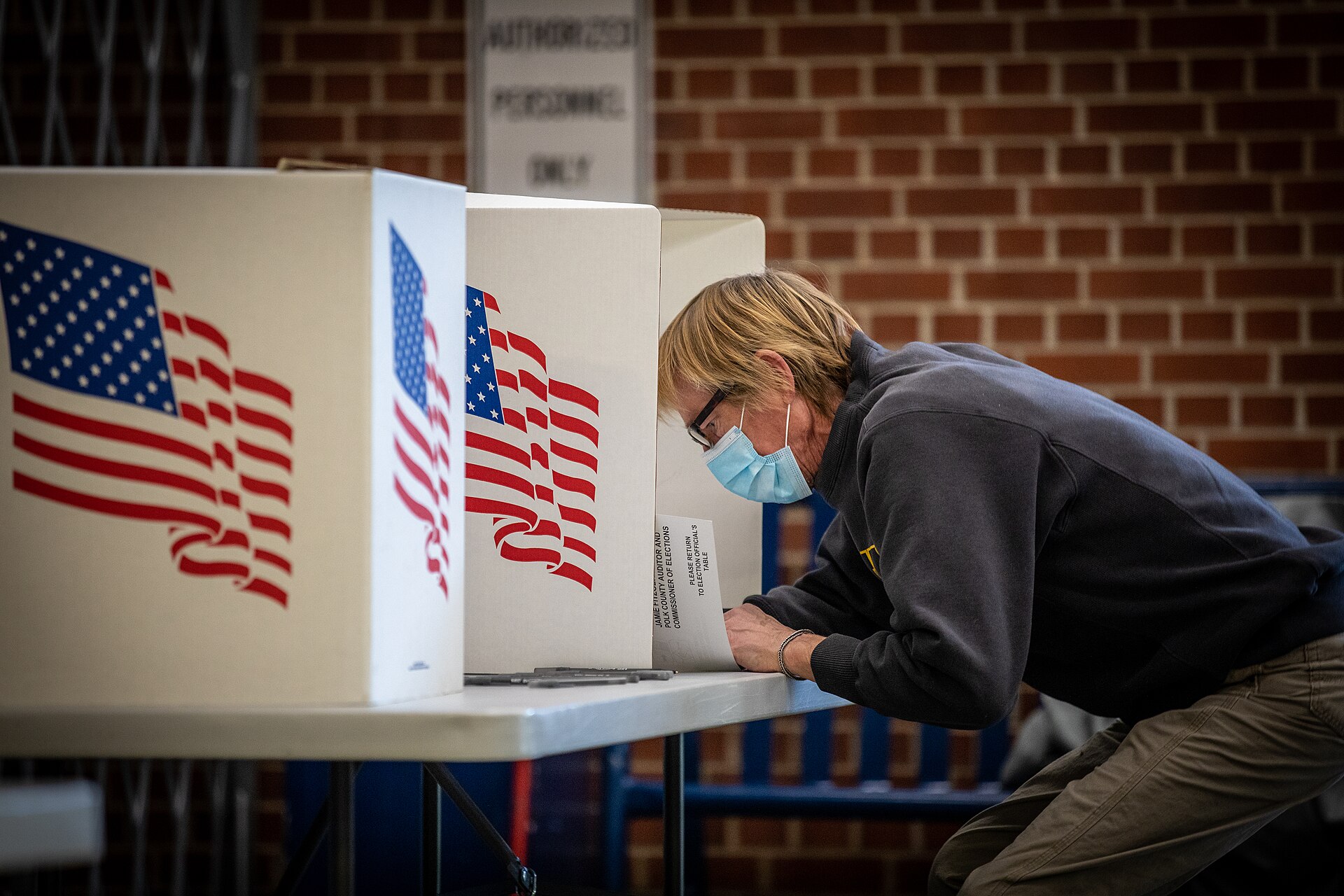
By the time the count in Mississippi stopped moving, at 3:03 on Wednesday morning, Eastern time, the Associated Press had already declared that Democrats had won the Senate, at 11:40 the night before, and the House, less than three hours after that. Democrat Scott Colom was ahead of Sen. Cindy Hyde-Smith by just 43 votes, in a state Donald Trump won by more than 20 points in 2024. That a Senate race there was still open at dawn is the clearest sign of what the night did. Kansas has not sent a Democrat to the Senate since 1932. Texas has not done so for 38 years. This week both did, along with Iowa, Ohio, Maine, North Carolina and South Carolina, which makes seven Republican-held seats that changed hands, according to the AP.
When we say the AP or NBC has “called” a race, we mean it has declared a winner because the remaining votes cannot change the result. We have not called any race ourselves. This piece is about why these results are unusual, who made history by name, what Republicans say went wrong, and what is still undecided. We argue that the night’s real record is not the size of the win but its reach: it went into states and districts that past results treated as safe for Republicans, and some of what it won is still being counted.
Control of both chambers
Start with what the parties held going in. Republicans held the Senate 53 to 47, counting two independents who vote with Democrats, and the House 219 to 214, according to NBC. Democrats needed a net gain of four Senate seats while defending every one of their own. They finished with 54 seats against 44 for Republicans in NBC’s count, with Mississippi and Alaska undecided. A president’s party usually loses seats in a midterm, but the Senate is harder to turn over than the House, because only a third of it is elected at a time. The AP’s own summary of the night is that Democrats flipped more than two dozen House districts as well, some of which Donald Trump won by double digits in 2024.
In the House, NBC counted 236 seats called for Democrats and 146 for Republicans at 12:14 pm Eastern on Wednesday, with 218 needed, and estimated Democrats would finish with at least 258. If that holds it would be the largest House majority for either party in nearly two decades, since the 257 seats Democrats won in 2008, as DTN reported. We compared NBC and the AP with outlets on the right, because we do not rely on one side. Fox News ran the headline that Republicans had suffered “historic midterm losses,” and carried a commentator’s description of a “blue tsunami.” We found no outlet on any side disputing that Democrats won control.
States that had not sent a Democrat in decades
The Senate flips are the part history books will list, and they fall into three groups. The first is the farm belt. In Kansas, Adam Hamilton, a megachurch pastor, beat Sen. Roger Marshall, 51 percent to 46, NBC and DTN reported, in a state where Trump won by about 15 points in both 2020 and 2024. No Democrat had won a Kansas Senate seat since 1932. Deseret News ties the result to historically high diesel prices for Kansas farmers and truckers. Next door in Iowa, Josh Turek, a Paralympian and state legislator, beat Rep. Ashley Hinson, 50 percent to 46, for the seat Sen. Joni Ernst is leaving. In Ohio, Sherrod Brown came back to the Senate by beating Sen. Jon Husted, who had been appointed to the seat JD Vance left.
The second is Texas, where the story is money. James Talarico, a state legislator, beat Attorney General Ken Paxton, which makes him the state’s first Democratic senator in 38 years; Al Jazeera adds that it is the first statewide win for a Democrat in Texas since 1994. Elon Musk is reported to have spent more than $200 million backing Paxton. That fits what we found in our own look at the cost of these midterms, that outside money was doing the work a candidate usually does. In Texas this time, it did not win.
The third is the South and the Atlantic coast, where Democrats took seats Republicans had held for years. In North Carolina, former Gov. Roy Cooper won the seat Sen. Thom Tillis is leaving. In South Carolina, Annie Andrews, a pediatrician, beat Republican Darline Graham, 51 percent to 47, in a seat that, by the AP’s account, Democrats last held in 1998. In Maine, Troy Jackson, with 53 percent, beat Sen. Susan Collins, who had held the seat since 1997. Democrats also kept their seats in Georgia, where Sen. Jon Ossoff won re-election, and in Michigan. Mississippi, a redder state than any of these, would belong to this group if Colom holds his lead, and its story comes below.
The firsts
The night also produced a list of people who are the first of their kind, and we give them with who reported each, because several come from one outlet. In Georgia, Keisha Lance Bottoms beat Republican Rick Jackson, who spent more than $100 million of his own money. NBC reports she is the first Black woman elected governor in the country’s history. NBC also reports that Deb Haaland, who won New Mexico’s governorship, is the first Native American woman to be a governor, that Peggy Flanagan, who won Minnesota’s Senate seat, is the first Native American woman in the Senate, and that Chris Pappas of New Hampshire is the first openly gay man in the Senate. Women will lead governors’ offices in a record 17 states, by NBC’s count.
In Michigan, Abdul El-Sayed beat Mike Rogers. Fox News and then NBC projected his win, and the Irish Times notes he would be the first Muslim senator. On the Republican side, the reporting we read says Byron Donalds, who won Florida’s governorship, is that state’s first Black governor-elect, and that Georgia is one of two Deep South states getting its first Black governor. All of these come from news organizations’ own projections and descriptions. We did not check them against official records, and the “first” claims are theirs.
Why Republicans say they lost
Republicans do not agree on why they lost, and that disagreement is news in itself. Vice President JD Vance wrote online that “the reason we lost is the war,” meaning the war with Iran, and asked whether anyone who thinks it was worth losing the Senate for six years should say so, according to the AP. Trump took a different line. After telling voters before the election to “pretend I’m on the ballot,” he wrote after it that “I wasn’t on the Ballot and if I was, we would have won IN A LANDSLIDE!” and, as the AP reports, blamed Republican candidates, saying Democrats “did a good job.” The same coverage says he called his decision to go to war with Iran “very wise.” Florida Gov. Ron DeSantis said the national party is in “a deep hole.” Three leaders, three explanations: the war, the candidates, and the party itself.
What did voters feel? The reporting we found points to prices more than any one speech. Deseret News links the Kansas result to diesel prices, which it ties to the Iran war, and a Fox News video segment said the word “diesel” was “looming large over the GOP.” Reading across the outlets we checked, our own view is that Republicans did not lose one thing. They lost where a war far away, fuel bills at home and a president who campaigned as if he were on the ballot all met in the same voter. We cannot prove that from results alone, because the exit-poll data that would show it was not available when we checked.
The fights over leadership have already started. The AP reports that House Speaker Mike Johnson will not run to lead House Republicans, that Majority Leader Steve Scalise will, and that Rep. Jim Jordan has also entered the race, according to Fox News. On the Democratic side, Sen. Chris Van Hollen would not say whether he will back Chuck Schumer as leader. And Trump, who first posted a picture of a red hat that said “Veto,” later congratulated Democrats and said he wanted to work with the new majority, as the AP and DTN both note. With the House, Democrats can subpoena officials, and with the Senate they can block nominees, but Trump still holds the veto. That is the next fight.
What is still not decided
Two Senate races and several House races are still being counted, and they will decide how large the win is.
Mississippi’s Senate race is the closest in the country. NBC has Democrat Scott Colom ahead of Sen. Cindy Hyde-Smith by 43 votes, 462,821 to 462,778, out of nearly a million cast, and the count has not moved since about 3 am Eastern. The Mississippi Free Press reports that Hinds County paused its count shortly after midnight and that thousands of affidavit ballots, which are ballots cast by voters whose eligibility has to be confirmed, remained to be counted; Colom’s campaign manager put them at at least 15,000. Mississippi has no automatic recount, and the BBC reports that candidates cannot request one. The AP has not called the race. It quotes Colom, who says he is confident of an eventual victory: “We have already shown the country that Mississippi matters.” If he wins, he would be the state’s first Democratic senator since John C. Stennis’s last election in 1982 and its first Black senator from the state since Blanche K. Bruce, who served from 1874 to 1881, the Free Press notes.
Alaska is the other. NBC has Democrat Mary Peltola ahead of Sen. Dan Sullivan by 626 votes, 102,701 to 102,075, with about 74 percent counted, after the lead changed hands more than once overnight. Alaska accepts ballots from overseas voters for 15 days after the election, and the AP says ranked-choice voting, in which voters rank candidates and the last-place names are dropped until someone passes 50 percent, applies if no one tops 50. A second candidate named Dan Sullivan is on the ballot, and the AP reports that Peltola’s campaign was accused of helping recruit him, which she denied. Four House races are also still open. In Colorado’s 4th District, Republican Rep. Lauren Boebert trails Democrat Eileen Laubacher, 49.2 percent to 47.7, with about 83 percent counted. In the 3rd, Republican Rep. Jeff Hurd leads Democrat Dwayne Romero by 1,211 votes, with about 81 percent counted, after Romero briefly led overnight. In North Carolina, Democrat Chuck Hubbard leads Rep. Virginia Foxx by 99 votes in the 5th District, and Rep. Greg Murphy leads Democrat Raymond Smith by 233 in the 3rd.
Two questions will tell us whether this night was a high-water mark or a new map. The first is how Democrats use the majority they have won against a president who still holds the veto. The second is how many of those seven Senate seats stay in play in 2028 and 2030, because six-year terms mean these winners will be on the ballot again with a different election around them. Until Mississippi, Alaska and the last House races are final, the record is not complete, and we will update this page when the Associated Press calls them.
Our editor, Ismail Abukar, reads the night this way, and we mark it as his reading, not a finding. He says the American people did something unbelievable on Tuesday, and that many of them may not yet know what it means for others, in the United States and beyond. In his view, history is often made when ordinary people feel they have not been heard, and then spend their time and energy getting to the polls anyway. Many people did not expect what happened, he says, and the voters who turned out should know they have changed something. The change is not abstract: it arrives on January 3, when the new Congress is sworn in and the House chooses its Speaker.
We add one point he did not make, so that readers do not expect too much of that day. The size of the Senate majority sworn in on January 3 depends on Mississippi and Alaska, and both counts, including Alaska’s overseas ballots, are still running. The change will come, as he says. How large it is will be known only when those two races are called.

Comments
Every comment is read by a person before it appears, so yours will not show straight away. We publish comments that are civil and on the subject. To report a mistake in the piece, use the corrections page, so it is fixed in the piece itself.