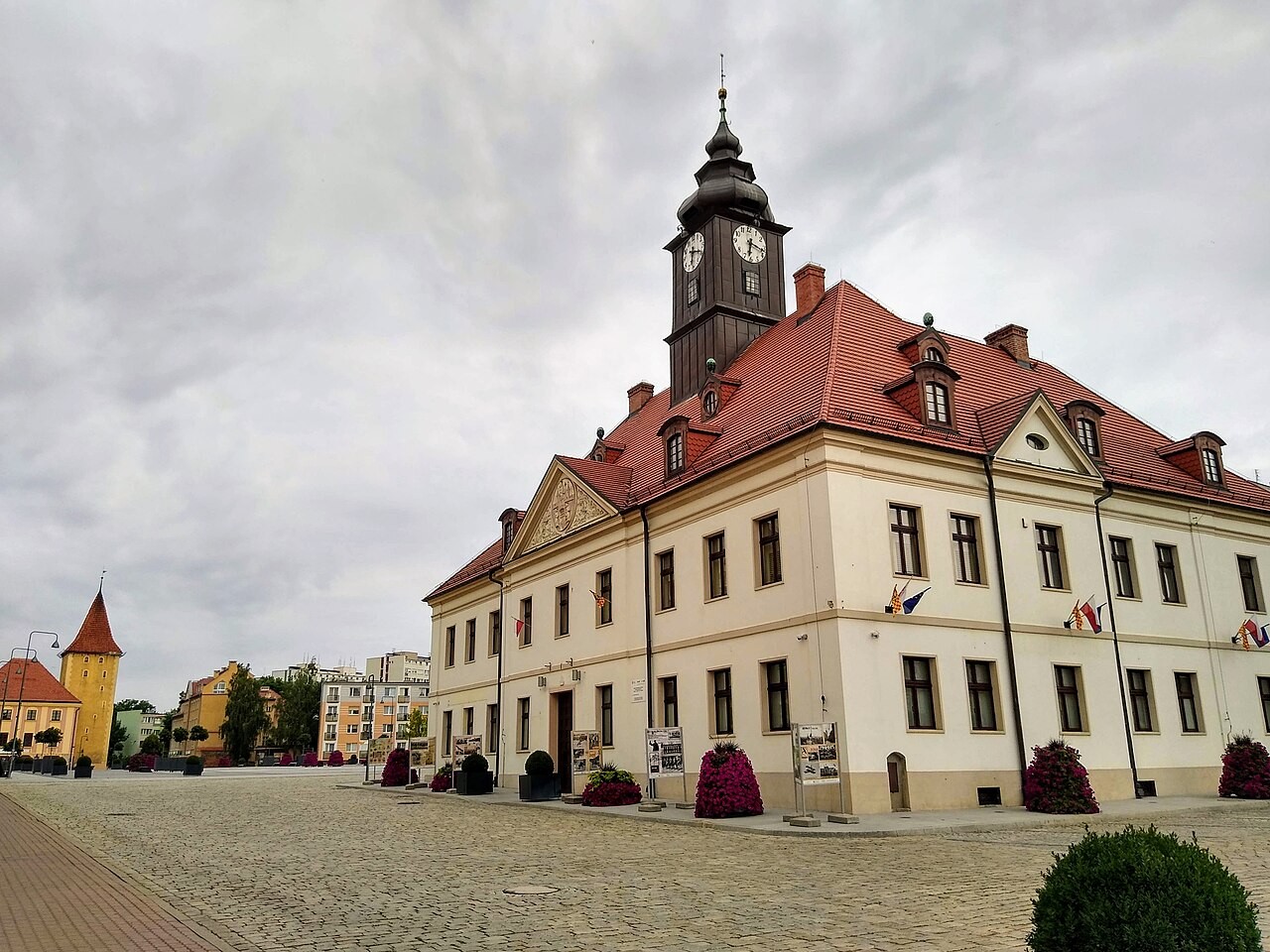
The transcripts of messenger conversations between the mayor of Lubin and a city official place a building on Zamojska Street in Lubin. The building stands in Lublin, a different city. Polish prosecutors listed that error among their reasons for saying that more than a thousand pages of such transcripts are forged, Rzeczpospolita reports. In May the same prosecutors charged five people with illegally spying on the mayor and other local officials, and one of the five, a former intelligence officer, with leading the group that did it, Interia reports. So the file now says two things at once, as prosecutors have set it out. The paper that fed the story was fake, and some of the spying it described may have been real.
This is the fight Poland calls the Lubin affair. On one side stand the mayor, Robert Raczyński, the newspaper Gazeta Wyborcza and the city’s own news portal. On the other stands Łukasz Bugajski, a man who says he was sent to do an intelligence officer’s bidding and whom prosecutors, according to the trade magazine Press, say never worked with the agency. Supporters of both sides have pointed to the charges as support for their own story. Our reading, set out below, is that the prosecutors’ public findings fit neither side whole, and that one lesson holds whichever side is right: a transcript is only as good as the proof that the conversation happened. Prosecutors give suspects only initials, and so do we. Bugajski is named in full because he tells his side under his own name, on a website and on X.
How a mayor became a story
In February 2024 the news site Onet and the TVN television programme Superwizjer published a report called “Dirty Game.” It said officers of the Internal Security Agency, Poland’s domestic intelligence service, known by its initials ABW, had illegally watched Mayor Raczyński and Andrzej Pudełko, a senior official in his city hall. It rested on nearly 1,000 pages of what were presented as transcripts of messenger conversations, according to Niedziela and Interia. In November, TVN24 and Onet followed up. They reported that recordings indicated the operation had been directed by a Captain Marcin P. of the agency’s Wrocław branch, and that one of their sources, Bugajski, said he had carried out orders from an ABW officer and taken part in illegal surveillance. The agency denied running an illegal operation.
The mayor said the material was invented. In an Onet interview in 2024, quoted by the city’s portal, he called it a pile of nonsense, the revenge of waste-industry firms angry that he had blocked a waste-incinerator plan. He sued Onet and TVN for 500,000 zloty each, according to Rzeczpospolita.
Another newsroom took transcripts somewhere else. Goniec.pl, a news site, ran a series that suggested the mayor and his aide were part of a scheme to abuse children, Wirtualnemedia reports. On 10 February 2026 its reporter Radosław Gruca said prosecutors held an expert opinion ruling out that artificial intelligence had written the conversations.
Then the prosecutors in Legnica, a city in the southwest, answered. In February 2026 they closed the child-abuse investigation, saying no offence had been committed, Wprost reports. Rzeczpospolita sets out their reasoning. The transcripts existed in three versions of the same conversation. The dates tracked the days media published stories, not the days of the supposed talks. The phone records did not show the meetings the speakers described. The child named in the chats did not exist, according to Wprost. Prosecutors said the writing had been done by someone who knew the speakers and local politics, and that it dated from 2021, before ChatGPT was available in Poland.
On 25 March Gazeta Wyborcza published a long article headed “1,000 pages of fakes: how a false agent tried to destroy the president of Lubin.” Gruca answered on X the same day that the expert’s method, which identifies an author by writing style, works like a fingerprint. Prosecutors had called the opinion a matter of probability, not proof, according to the trade magazine Press, in a critical profile of Gruca. On 30 March he announced he was leaving Goniec. Press reports that he was laid off in a company restructuring and that former colleagues think he was led astray. It also reports that prosecutors found the material had been sent from email addresses Bugajski used.
Two readings of one set of charges
Bugajski rejects all of that. Wprost reports that he calls the investigation rigged and has not answered Wyborcza’s questions. On X he says that since 16 March recordings have been published on the channel of the journalist Jan Piński in which, he says, Captain P. instructs him. In another post he says the captain extorted money from a Lubin businessman, Maciej Bodnar, and that on the captain’s orders he was sent to Bodnar with material and a story meant to make him feel under threat.
In a long reply to Wyborcza, also on X, he says the email address the newspaper ties to him was used by several people, including Captain P. on his instructions. He says he never gave prosecutors transcripts of the mayor’s conversations, only recordings of talks he took part in himself, and that it was the captain who obtained the transcripts. He added that no charge had been brought against him. Piński says the same about the child-abuse transcripts, in Wprost’s account. Bodnar’s wife, the member of parliament Izabela Bodnar, wrote in March that her husband had been introduced to Bugajski by Captain P., Wrocławskie Fakty reports, and that one man could not have invented it all alone. All of this is their account. None of it has been tested in a court.
Then came May 2026. The charges named a former ABW officer, Marcin P., as the head of an organised group. The agency said, in a post on X reported by the city’s portal, that his actions were outside his duties and came before December 2023, and that he left the agency in 2024. It added that the agency as an institution did not carry out such operations. Igor N., a police officer, is accused of looking people up in police databases without authority for others in the group. Two more members, Łukasz B. and Filip Cz., are named, but their charges have not been announced. They have since told us that these are Łukasz Bugajski and Filip Czaja, and they consent to being named. The man accused of commissioning the surveillance is Maciej B., who RMF24 reports is the husband of Izabela Bodnar. She said he is innocent and a victim.
After publication the agency answered our questions. Its press team told us on 10 November that the District Prosecutor’s Office in Legnica has been investigating since April 2024, and that the agency carried out no surveillance in this case. It said that none of the circumstances raised by Bugajski related to the official duties of its officers, and that it is working with the prosecutors and giving them the information and documents they need. It repeated that Marcin P. acted outside his duties before December 2023 and left the agency in 2024. The agency also said that the Legnica investigation covers what it calls Bugajski’s impersonation of an ABW officer and his giving of false testimony in other proceedings. We could not find this in the two prosecutor statements the agency pointed us to. Czaja replied for both men on 10 November. He said they have been given no details of any charge of impersonating an ABW officer or giving false testimony, that neither of them has been questioned on suspicion of either offence, and that they do not know which events the agency means, so they cannot answer in detail. He said that in October 2025 a report attributed to Bugajski reached the tax office in Lubin, that Bugajski says he did not send it and was abroad at the time, and that Bugajski’s lawyer reported it as a suspected crime in January 2026. He also rejects the agency’s description of their contact with Marcin P. as unrelated to his service, and says they have records of part of it that we have not seen.
Each side took what it needed. The city’s portal ran the news under the headline “Fake transcripts, real charges,” presenting it as confirming the mayor’s account. One commentator on X wrote that the charge against an intelligence officer meant Wyborcza’s attempt to discredit Bugajski had failed.
What neither side has explained
The mayor’s account has to meet the surveillance charge. When he sued the broadcasters he said their reports about surveillance by the ABW were false, according to Niedziela. Prosecutors have since charged people with illegally spying on local officials, with the mayor as the main target. That does not make the broadcasters right about a state operation, which prosecutors and the agency deny. But what Onet and TVN reported, and how much of it was true, is exactly what the civil court in Legnica must now decide. Rzeczpospolita reported in March that the case was suspended while the criminal one went on.
Bugajski’s account has to meet three points. Marcin P.’s charge fits his claim that a rogue captain was behind the operation. It does not explain why Maciej B., the man his camp describes as the captain’s victim, is the one charged with commissioning the spying. Nor does it by itself answer Press’s report that prosecutors found the forged material was sent from email addresses he used. Bugajski’s reply is that several people used the address, the captain among them, and we cannot check that. Bugajski and Czaja told us they are the Łukasz B. and Filip Cz. named in the prosecutors’ decisions, that the charges against them have not been formally announced, and that they were in Morocco when the searches took place in May.
The newsrooms have to answer for the transcripts. Onet and TVN reported a state operation. Goniec suggested a child-abuse scheme. Wyborcza reported forgery. They cannot all be right, and we could not find a statement from Onet or TVN responding to the prosecutors’ findings. Goniec’s reporter has left. A man who gave recordings to one newsroom and, according to Press, appeared on another’s programmes is now called a false agent by a third. A thousand pages of chat are only as good as the proof that the conversations happened, and prosecutors say that proof is not there.
What would settle it
Four things. An indictment, the formal accusation sent to a court, which would set out who prosecutors think made the transcripts and what the undisclosed charges are. The forensic evidence on the transcripts, which has so far reached the public only through the press. The Legnica civil court’s ruling on the mayor’s suit. And the separate complaints Bugajski says he has filed against officials and against Gruca, none of which we have seen decided. We found no report of an indictment as of 1 November.
Until then, every transcript in this affair, from every side, is unproved, and every charge is only a charge.
What to watch. Whether prosecutors indict and say who made the transcripts, whose charges have not been announced, and what the Legnica civil court decides about the mayor's suit against the broadcasters.
Comments
Every comment is read by a person before it appears, so yours will not show straight away. We publish comments that are civil and on the subject. To report a mistake in the piece, use the corrections page, so it is fixed in the piece itself.