
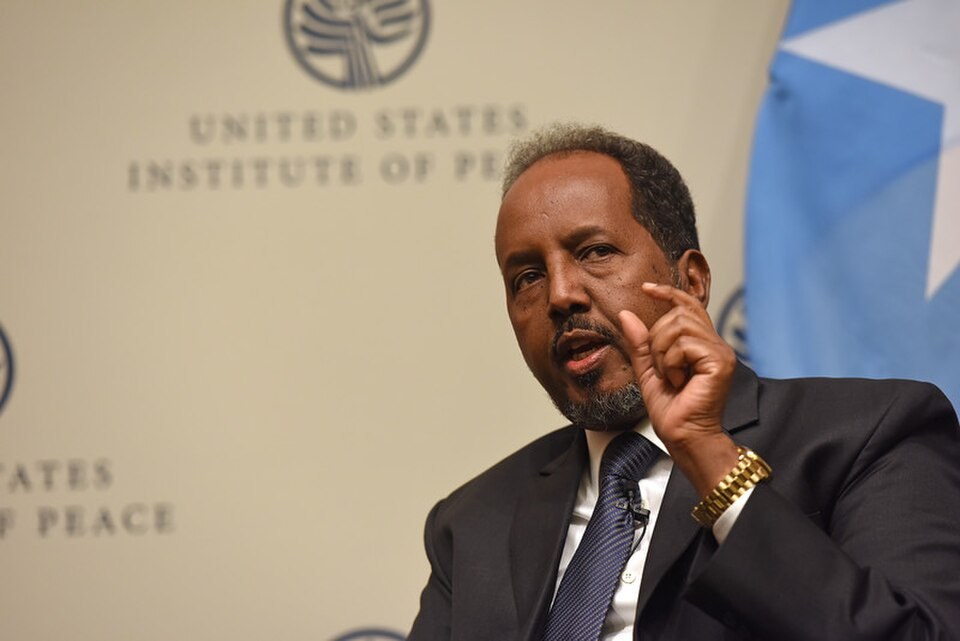
On Thursday night, October 15, hours after the electoral commission announced the dates, President Hassan Sheikh Mohamud told a room of lawmakers that Somalia’s elections will go ahead on the government’s terms. The Somali Guardian reported that he rejected negotiations with opposition leaders and said efforts to oppose his plans would fail. WardheerNews, which is critical of him, quotes the line that “there will be no such consultation”. State television broadcast the speech, so the whole country could hear it. It ran about five minutes. The journalist Ali Adan Mumin posted it on video, and I watched it.
Ten days later, on Sunday, October 25, the same president went on television and said the door to dialogue was open “at all times and under any circumstances”, Dawan Africa reported. His office invited the opposition alliance, Farmaajo’s party and others to a consultative forum in Mogadishu from November 14 to 18, FTL Somalia reported. He also said that the power to decide cannot be left in the middle. The door that was shut on the fifteenth was open on the twenty-fifth, but the person standing in it still decides what comes through.
The commission that will run the vote says it is independent, and the dates it has announced were welcomed by the government the same day. The commission is independent on paper and dependent on the government in practice, that the reopened door changes the tone and not the arrangement, and that the opposition is right about the question it keeps asking: who decides how the vote works.
What the president said
His main point on October 15 was about who decides. In past elections, he said, the government and the opposition sat down, argued, and agreed how the vote would run. Whatever they agreed became the rule. He said that will not happen this time. Holding elections is the government’s duty, and it will do it the way it chooses.
He left a door open then too, but only a narrow one. If the opposition has concerns, he said, it can bring its ideas to the government. The government will accept the ideas it finds good and keep its own plan for the rest. He also tried to calm fears about safety. He said the opposition thinks the government will attack it, and that this is not how his government solves problems. It will not raid opposition members’ homes, frighten them or arrest them, he said, and no opposition figure is in prison now. I have not checked that claim. The other half of his message was a warning: anyone who attacks the government or causes insecurity, in Mogadishu or anywhere else, will be met with force.
The MPs were in the room, but they were not the people he was speaking to. He did not name anyone, and what follows is my reading. State television carried it live, which suggests he meant it for the opposition, for ordinary Somalis, and for the foreign governments that watch Somalia from the Halane compound at Mogadishu airport. His message to all of them was the same: the government decides how the election works.
To show that elections will be fair, he pointed to Galmudug. The Supreme Court cancelled the July 30 vote there, he said, and the government did not fight the ruling. It held the vote again, and the court approved the new result. The facts are correct. The new vote took place on September 30, and the court approved the result on October 13. But Towfiiq, the party that won the case, was not allowed to take part in the new vote, which the same commission ran. I wrote about this in my report on the Galmudug election. The speech does not say whether the court can do the same job in a national election, and that is what the opposition is asking.
Why the opposition says no
The dates came first. Parliament will be elected on April 15, 2027, and the president on May 15, 2027, Garowe Online reported. Registration of voters and parties runs from November 1 to 22. Both houses of parliament will be chosen on a one-person, one-vote basis, which means each adult votes directly and clan elders do not choose for them. The commission said the president’s date follows the rule that a president serves five years from the day he is sworn in. That rule is in the new constitution, which parliament approved in March, according to The EastAfrican. Under the constitution, parliament, not the public, elects the president, and the five-year terms are why the government says his term now runs to 2027 and not 2026.
Opposition leaders rejected the dates on the day they were announced. Mohamed Aden Jimale, known as Koofi, the secretary of the Somali Salvation Forum, accused the government of “election theft”. Former President Mohamed Abdullahi Farmaajo called the plan one-sided and warned of rival elections and conflict. On October 19 the Somali Future Council, the opposition alliance, put its rejection in a formal statement: the timetable was announced without an inclusive political agreement, talks should resume with international mediation, and the president and his supporters would bear responsibility for any consequences. The president’s October 25 invitation did not accept mediation, and FTL says the government rejects it as an infringement on sovereignty.
Their complaint is about more than the dates. They want the government and the opposition to agree on the kind of election first. They also reject the new constitution that parliament passed this year, and say the government is using it to stay in power longer. Opposition lawmakers stayed away from that vote, according to The Somali Digest. Former President Sharif Sheikh Ahmed says he asked the Supreme Court on October 11 to annul the constitutional changes, and the Somali Guardian reports the court gave the government until October 22 to present its defence. Justice Minister Hassan Macalin said the case had been sent to the Attorney General and that the government would defend the amendments, calling the opposition’s move to the courts a sign of confidence in the rule of law, Dawan Africa reported. I found no hearing date or ruling.
On October 25 Puntland’s president, Said Abdullahi Deni, said at the opening of his parliament’s session that Puntland would not accept an election process designed solely by Villa Somalia, the presidential palace, and called for an urgent national conference, Garowe Online reported. The president’s invitation came the same day.
What the vote count says
The state elections the president offers as proof have all ended the same way. The ruling party won most seats every time. In South West its Justice and Solidarity Party (JSP) won 51 of 95 seats, and the Supreme Court approved the result on May 25. In Galmudug it won 67 of 89 seats, and on October 22 the House elected its candidate, Liibaan Ahmed Hassan, president by 72 votes to 14, Dawan Africa reported. In Hirshabelle it won 78 of 99, and on October 24 the House re-elected President Ali Abdullahi Hussein “Guudlaawe”, 81 votes to 13. Hirshabelle’s outgoing vice president, Yusuf Ahmed Hagar, known as Dabageed, said any result from “that sham” does not apply to Hiiraan, according to FTL Somalia.
The opposition’s reaction was mixed. Former Prime Minister Mohamed Hussein Roble and others congratulated the Galmudug winner while saying this did not withdraw their objections to how the elections are run. The Somali Guardian called that a “political own goal” that may weaken their challenge, which is its analysis. I read it as a sign of how hard it is to stay outside a process that keeps producing office-holders.
What the commission needs from the government
The head of the commission, Abdikarim Ahmed Hassan, also spoke this week, in a video interview with Ali Adan Mumin. I watched it, and this account comes from the video. He said the commission has already been tested. It started with the first election in Shangani district in Mogadishu, where each adult votes directly, and then ran elections in about 40 districts in two states, Galmudug and Hirshabelle. When the Supreme Court rejected the first Galmudug vote, he said, the commission accepted the ruling and held the vote again. He did not mention South West State, but the commission also ran the vote there in May, in 13 districts. He promised that disputes during the vote can be settled and that mistakes can be corrected. Voter cards were first handed out in Mogadishu in November 2025, and Shangani was one of the first seven districts. I could not check his number of 40 districts. It is his figure.
He also said the commission is independent, and that it needs only three things from the government: money, security and political support. The Somali word he used for the third was siyaasad, which means politics. I understood him to mean political support. On the day the commission published its dates, Deputy Prime Minister Salah Jama gave a press statement that welcomed the timetable and said the opposition can bring ideas, and the government will accept the ones it finds acceptable. I watched it. The government approved the dates, and the opposition may suggest changes but will not decide them.
What follows is inference, not a finding. A body that gets its money, its protection and its political support from the government is not independent in any way a voter can check. The one who pays can cut or delay the money. The one who provides security can take it away, or fail to provide it where it matters. The one who gives political support can withdraw it. This does not prove that the commission has taken orders. It means the commission cannot refuse an order without risking all three. I have no evidence that the commission acts this way, and many election bodies in other countries also get their budget from their governments. The test is simple. Does the law guarantee the commission’s money? Who chooses its members, and who can remove them? Who protects its staff on voting day? I have not seen these answers published, and found no reporting on what the 2027 vote will cost or who pays.
Could it have gone differently?
The government could have settled the model before announcing the dates. A forum in November would have been a stronger answer to the opposition’s complaint in September, before the timetable, the constitution and the court case hardened positions. Having said on October 15 that there would be no such consultation, it now asks the opposition to attend a forum at which it has already said what it will and will not accept. The opposition, for its part, boycotted the March vote on the constitution and then went to court, and it congratulates winners of elections it calls illegitimate. Staying out of the process leaves it with few ways to affect the result.
The best case for the government
The strongest objection is that governments organise elections, that this one has run votes in four places and held them under a court’s supervision, and that talking is exactly what the president now offers. The commission’s record is real, and a court that voided one result and approved the next is not a rubber stamp. The reopened door is also real. But the offer is to discuss additions to a plan, not the plan. If the commission is independent and the process is fair, publishing its funding, its appointment rules and polling-station results would show it. That costs the government nothing it should want to keep.
I have not seen the full text of the constitution, and I do not have its article numbers. One legal analysis calls the March changes amendments to the 2012 provisional constitution that still need a public vote to become permanent, while the government and other reports call it a new constitution. I do not know whether the opposition’s Nairobi meeting has taken place, or whether the alliance will attend the November forum. The Dawan report says talks are expected in early November, which differs from the forum dates. I do not know whether the Supreme Court will decide the case against the constitution before registration opens on November 1.
On October 15 a president told a room that there would be no such consultation. On October 25 he told the country that his door was open. Between the two came the alliance’s formal rejection, Puntland’s refusal and a court challenge, and what the forum can show is whether the person who decides will let any of that change the plan.
Comments
Every comment is read by a person before it appears, so yours will not show straight away. We publish comments that are civil and on the subject. To report a mistake in the piece, use the corrections page, so it is fixed in the piece itself.