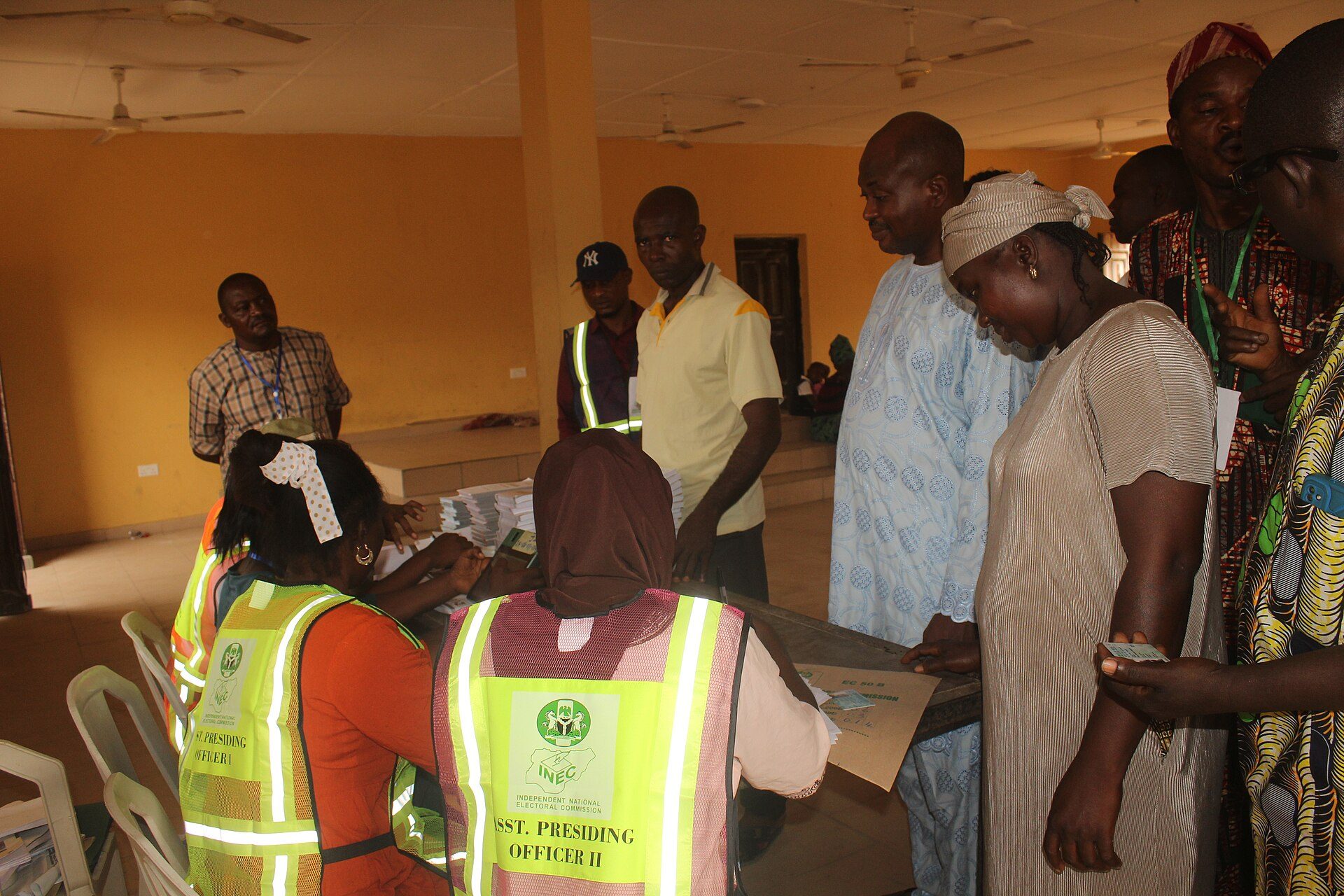
Nigeria votes for a president and the National Assembly on January 16, 2027, after the Independent National Electoral Commission (INEC) revised its timetable in February, Channels TV reported. Campaigns opened in August. Before they intensify, one question deserves an answer: which women are allowed to take part safely?
In every election cycle in Nigeria, we count votes. But we rarely count the voices that are missing. For many women, especially survivors of gender-based violence (GBV) and women with disabilities, elections are not just a civic duty. They are a site of fear, exclusion and renewed trauma.
I have worked on GBV prevention, disability inclusion and voter education across communities in Nigeria. I have seen firsthand how violence and exclusion work together to silence women long before election day.
Gender-based violence in Nigeria is pervasive. In the communities where I work, women tell me that this violence often gets worse around elections. The 2018 Nigeria Demographic and Health Survey found that 31 percent of women had experienced physical violence and 9 percent sexual violence, Dataphyte reported, and that more than half of the women who suffered either never sought help. UN Women says the latest survey, in 2024, found lower figures, 19 percent for physical violence and 5 percent for sexual violence, Newscentral TV reported. That is a fall, but it still means roughly one woman in five.
Women have told me they were threatened by partners or community leaders for expressing political opinions. Some are told who to vote for. Others are forbidden from attending political rallies or campaign events for fear of being labelled “wayward.” For survivors, the trauma of violence creates a deep distrust of public spaces and of the institutions that are supposed to protect them. If a woman has been assaulted and could not get justice, if police asked her what she was wearing, if her family told her to be silent, if the health centre had no counsellor, why would she trust that same system to protect her at a polling unit?
Election violence adds to this. In the March 2023 governorship elections, the election-monitoring group Yiaga Africa verified 216 serious incidents and at least eight deaths in 24 hours, ThisDay reported. A later report by IRIAD, a Nigerian research and advocacy group, working with INEC’s gender department, found violence against women and people with disabilities “prevalent” in the Kogi, Bayelsa and Imo governorship elections, the News Agency of Nigeria reported. When elections turn violent, women retreat first. And when they retreat, democracy shrinks.
We do not even know how often this happens. After the 2023 elections, UN Women’s representative in Nigeria told a conference that the lack of data on violence against women in politics weakens the case for action, UN Women reported. It is hard to protect voters whom nobody counts.
Women’s exclusion also shows in who holds office. Women hold 16 of the 360 seats in the House of Representatives and 4 of the 109 in the Senate, ThisDay reported. That is 4.4 percent of the House and 3.7 percent of the Senate. A bill to reserve extra seats for women, 12 in the Senate, 37 in the House and 108 in the state assemblies, had not come to a vote when the House went on recess in June, Sahara Reporters reported.
If women in general face barriers, women with disabilities face a double exclusion.
Nigeria has no reliable national count of people with disabilities. The World Bank, citing the World Health Organization, put the number at about 29 million in 2018, in a 2020 assessment, and the Africa Disability Rights Yearbook lists other estimates that are far lower. Whatever the true number, access to polling units remains a major problem. In many rural areas where I work, polling units are in schools with no ramps and no accessible toilets, and in my experience sign language interpreters, braille ballot guides and electoral information in accessible formats are rarely there.
INEC has made promises. In April, its Ogun State commissioner, Feyijimi Saseyi, said voters with disabilities, elderly voters and pregnant women would get priority at polling units in 2027, with braille guides among the aids, and that “nobody will be excluded,” The Guardian reported. Observers do not agree on how well promises like that are kept. In Ekiti State’s June 2026 governorship election, TAF Africa reported “serious accessibility gaps” for voters with disabilities and elderly voters in parts of Ado-Ekiti, including staircases to polling units, the Situation Room coalition of election observers reported. The International Press Centre, observing 88 polling units, found 89.9 percent of them physically accessible, Peoples Gazette reported. INEC told disability groups in September that it had registered 137,487 voters with disabilities so far, a figure taken before its fingerprint-matching step, Blueprint reported.
A woman with a physical disability who trades at a market in Ado-Ekiti, Ekiti State, told me: “They want our votes, but they don’t want us to come and vote.” In 2019, she had to be helped across a drainage channel to reach her polling unit.
For women with disabilities who are also survivors of GBV, the situation is even more dire. Women with disabilities who survive violence tell me that police stations, courts and shelters are themselves hard to reach, so many never get justice. Inclusion cannot be an afterthought. It must be budgeted for, planned for and monitored.
On disability, section 9 requires INEC’s register of voters to record disability status by type, and section 54(2) requires INEC to take “reasonable steps” to help voters with disabilities through “Braille, large embossed print, electronic devices, sign language interpretation, or off-site voting in appropriate cases.” What the Act does not do is mention gender-based violence. I also could not find in it any rule that polling units must be accessible, or that voters with disabilities must get priority. So INEC’s promise in Ogun is a promise of policy, not a duty written into the law.
Where justice fails, participation dies
One of the most painful realities for survivors is the failure of justice. In the communities where I work, women tell me that cases are reported but not investigated, that survivors are blamed, and that some perpetrators walk free and later become community leaders or political actors. When a survivor sees her abuser celebrated politically, she learns that her body and her voice do not matter. That has direct consequences for turnout. In a community dialogue in Ibadan, Oyo State, in early 2025, women told me they would not vote because “the people who beat us are the ones sharing money for votes.” Violence creates political apathy, not because women do not care, but because the system has taught them that their safety is not a priority.
This is especially damaging for young women and first-time voters. If their first encounter with politics is intimidation or sexual harassment at a campaign rally, they may disengage for good.
The law is not silent, and that matters for what we ask. Section 97 of the Electoral Act 2026 makes it an offence to threaten anyone with force or violence during a campaign in order to make them support, or refrain from supporting, a party or candidate. A candidate can be fined up to ₦5 million or jailed for 12 months, and a party can be fined ₦10 million, according to the text of the Act published by the Policy and Legal Advocacy Centre. That describes what women have told me: threatened over their opinions and told who to vote for. I do not know whether anyone has been charged under it, and that is a question for the police.
What must change
Nigeria cannot hold credible elections without putting safety and inclusion at the centre, and four steps are urgent.
First, security agencies need GBV desks during elections. Police and civil defence officers deployed for elections should be trained on preventing and responding to GBV, with clear referral routes for survivors who are attacked at or near polling units. The police should also say how many complaints of threats under section 97 they have received and what became of them.
Second, INEC must carry out the duty the law already gives it. That means more than ramps: accessible voter education materials, sign language interpretation at collation centres, where results are added up, tactile ballot guides that blind voters can read by touch, and priority voting for pregnant women, nursing mothers and people with disabilities. Before January, INEC should publish how many polling units will have ground-level access and where the tactile guides will be, so that observers can check the promise rather than take it on trust.
Third, political parties must adopt zero tolerance for GBV. They should have internal codes of conduct that punish members who harass, intimidate or sexually assault others during campaigns. Women’s wings should not be reduced to singing and dancing. They must be empowered to influence policy.
Fourth, civic education must address GBV directly. Voter education should teach people not only how to vote, but where to report violence, how to support survivors and why inclusion matters. Traditional rulers, faith leaders and community influencers must be engaged as allies.
Comments
Every comment is read by a person before it appears, so yours will not show straight away. We publish comments that are civil and on the subject. To report a mistake in the piece, use the corrections page, so it is fixed in the piece itself.