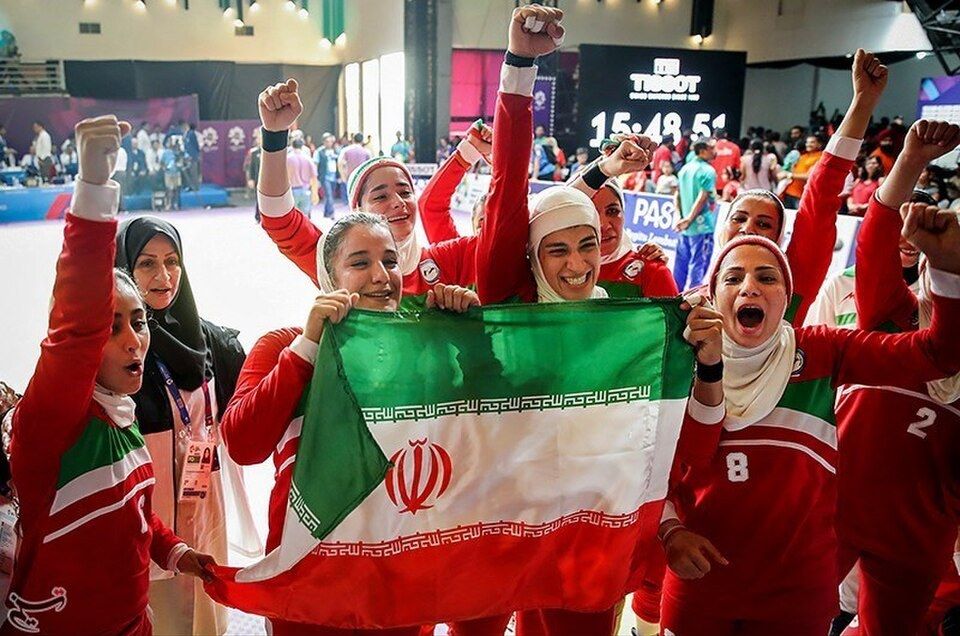
On 4 October, Iran’s president praised the country’s women athletes, according to state-run Press TV, after the Asian Games in Japan, where Press TV counted 15 medals and the Olympic Council of Asia counts 14. The same Games showed how much the state still decides. A gymnast from Mashhad became the first Iranian woman to compete in her sport at the Games since the 1979 revolution. The women’s football team was not sent.
The medals are real, and the women worked hard for them. But a medal shows who won. It does not show who was allowed to try. This piece argues that the Iranian state sends women abroad to win and takes credit for the wins. At the same time, it keeps control of the rules that decide how many women get the chance: what they wear, whether they may travel, and where they compete. Those rules are decisions made by people, and the evidence shows that people can change them.
What the medals hide
Iranian women won 14 medals in Nagoya: three gold, six silver and five bronze, nearly 27 percent of Iran’s total, according to the Olympic Council of Asia (OCA). IranWire counted the same 14, while Press TV gave the president’s count as 15. This piece uses 14. Women were 95 of Iran’s 305 athletes, and they were missing from more than ten sports. That is progress, with limits.
Women’s sport also has fewer resources. A 2025 study of Tehran puts the city’s sports space at less than half a square metre for each person. The study calls two square metres desirable. It does not say where its estimate comes from. A Persian-language feature in the magazine Hafteh lists lack of space among the problems of women’s sport and says women have little room to exercise. Many women’s competitions are not shown on state television. In 2020 IranWire quoted the footballer Golnoush Khosravi, who said coverage of women was “not even 10 percent” of what men get. A medal hides these problems for a while. It does not remove them.
The women prepared for the Games in a country at war. According to the OCA, the rowers were told to stay indoors when the war began and spent about seven weeks away from their boats, training at home on rowing machines. Kimia Zarei said she rowed 20 kilometres a day on the machine, and that going back to camp meant “we risked our lives because we wanted this moment.” Their training ground had problems even before the war. In the summer of 2023 the water in Tehran’s Azadi rowing lake fell so low that, Independent Persian reported on 1 August 2023, the national team struggled to train. The head of the rowing federation said the lake was turning into a skating rink.
Zarei and Zeinab Norouzi still won gold in the lightweight double sculls, a two-person rowing race, and Fatemeh Mojallal won gold in the lightweight single sculls. It was the first Asian Games rowing gold for an Iranian woman.
Kabaddi, an ancient Indian team sport that Iran now dominates, felt the war too. The OCA reported on 22 September that the war had cost the women’s team training time, and that it spent six days at a camp in Sonipat, India, to gain match practice. At a course for team managers in Tehran on 18 August, the secretary-general of Iran’s National Olympic Committee, Mahdi Alinejad, said the country was in “special circumstances”. The OCA’s report says training camps were closed for a time and that the government had paid for the delegation’s travel. The women lost the final to India, 37 to 34, and took silver.
Iran has sent women to the Asian Games before, within narrow limits. In 1990, in Beijing, Iran’s women’s team was six shooters aged 19 to 27, according to the Chinese newspapers Cankao Xiaoxi and People’s Daily. Both described them in black veiling from head to toe, even in heat above 40 degrees Celsius. A team official told People’s Daily that shooting was the only sport in which Iranian women could compete abroad.
Thirty-six years later, Iranian women competed in Nagoya in rowing, karate, weightlifting, athletics, gymnastics, kabaddi and basketball. Reyhaneh Karimi won bronze in the 77kg weightlifting class, the first Iranian woman to win an Asian Games medal in the sport. That is a real change. The question is who controls how far it goes.
For a woman in Iran, choosing a sport raises questions a man never has to ask. Will religious authorities approve the clothing? Will the uniform meet international rules? Will the movements be accepted? Will men be in the audience? Clerical views differ, and state institutions turn those views into rules about uniforms, venues and travel. Sending women abroad can help the Islamic Republic answer critics of its treatment of women, as long as their clothing and behaviour stay inside the limits the state sets.
Gymnastics shows how this works. For decades Iranian women did not compete in the sport at the Asian Games, largely because the dress code clashed with the sport’s clothing rules. IranWire reported that in 2019 the International Gymnastics Federation gave preliminary approval to a changed outfit that Iran proposed. Even so, the report said, the sports ministry refused travel permits. In March 2023, it said, Mahin Farhadizadeh, then the National Olympic Committee’s vice-president for women’s affairs, said standard gymnastics clothing violated the Islamic Republic’s “cultural considerations and standards”.
In Nagoya, Hengameh Hadiani, 20, from Mashhad, competed on the vault and finished 13th in qualifying. She won no medal. The reports do not say what she wore or what was agreed. But the change itself matters. Something was decided differently, which suggests that the earlier refusal was a choice, not an unchangeable principle. Women athletes and the state need each other, and it is an uneasy arrangement: the state wants the victories abroad, yet the clothing it demands can make winning harder than it is for rivals.
The price of stepping outside the limits
In October 2022 the Iranian climber Elnaz Rekabi competed in Seoul without the compulsory head covering, as protests spread across Iran after the death in custody of Mahsa Amini. Images of her climbing spread quickly, and many people saw them as an act of defiance.
IranWire, citing the BBC, reported that before she travelled, Rekabi had to hand over a $35,000 cheque and give Iran’s climbing federation the legal right to sell her family’s property, reportedly as a guarantee that she would return. IranWire’s own later report, based on a source it did not name, said she was held under house arrest at her father’s home in Zanjan afterwards and barred from meeting other athletes, giving interviews or using her phone. I have not been able to confirm these accounts independently.
The football team’s absence from Nagoya stood out because its players had been at the centre of an international controversy only months earlier. At the Women’s Asian Cup in Australia in March 2026, they stood silent during the anthem before their first match, against South Korea, a gesture widely seen as defiance. Mohammad Reza Shahbazi, a state television presenter, called them “traitors” and said they must be dealt with more severely. Six players and one staff member were granted Australian humanitarian visas. Most of the squad returned to Iran.
Was the team’s absence a sporting decision, or a result of that controversy? The reports do not say how it was decided, so this piece does not claim it was a punishment. But if a team’s conduct abroad is followed by consequences for its later chances, other athletes may learn that speaking out puts more than themselves at risk.
An Iranian athlete who wins a medal raises the national flag, which is also the flag of the Islamic Republic, a symbol many Iranians reject. The state can present her win as proof that it has created the conditions for women to succeed, while her own experience may be different. Not all Iranians accept that picture. Before the 2022 World Cup, a Tehran university student told Reuters: “It is not Iran’s team, it is the Islamic Republic’s team.” The National quoted him. Kimia Alizadeh, who in 2016 became the first Iranian woman to win an Olympic medal, later left Iran and wrote, in a letter IranWire reported, that officials “put my medals at the foot of compulsory hijab.”
Official recognition has also been modest. In June 2023, after Nahid Kiani won Iran’s first women’s taekwondo world title, the Tehran provincial sports directorate gave her five million tomans, in Iran’s currency. She criticised it in a story she posted online. The directorate’s head, Ali Javadi, told the news agency ISNA that the money was given so that her certificate of appreciation would not be empty, as reported by Donya-e-Eqtesad. In May 2026 she told the newspaper Etemad that the sports ministry had not yet paid her anything for her Asian title.
The road to Nagoya probably owed as much to pressure from below as to official generosity. Athletes and coaches pushed for access, administrators found ways to meet international requirements, and women challenged limits that had been presented as fixed. Iran’s usual picture of sporting success has long been powerful men in wrestling singlets. Now it includes women in rowing boats, on gymnastics equipment and on a kabaddi mat. They travel as representatives of a state that wants to claim their success, even when their achievements came from persistence against limits that the state helped impose.
Many of the limits described above were decisions, not laws of nature. Decisions can be made differently.
I would not place my hopes in the institutions that have spent decades deciding how far Iranian women may go. Whatever changes have taken place in women’s sport have often begun with people testing the limits of what was considered possible, finding room to move where little had been left to them. Like a seed working its way through stone, the change has been gradual, sometimes barely visible, but difficult to dismiss. It belongs to the same wider story as the changes taking place in streets, universities and other parts of Iranian society, where women continue to make their presence felt.
The significance of these athletes lies partly in how much they have achieved, but also in the possibilities their achievements have opened up for others. A boundary crossed by one woman may become a little less fixed for the next, even when the change is partial and the risks remain. Their futures will not all look the same, and there is no single path they should be expected to follow. But their connection to the society they come from matters. The opportunities they have claimed were not simply gifts from officials; they have been shaped by the efforts of athletes, coaches and people who have pushed for change, often at considerable cost. Their medals belong to them. The space they have helped create reaches beyond the podium.
What to watch. Three things will show whether Nagoya was a turning point or an exception. The first is whether women gymnasts receive travel permits for the next international competition, now that a woman gymnast has competed at the Asian Games. The second is whether Iran’s women’s football team is chosen for its next international tournament. The third is whether the National Olympic Committee explains its rules on uniforms and travel, and says whether athletes are asked for financial guarantees.
What is not known. It is not known why the women’s football team did not go to Nagoya. It is also not known how widely financial guarantees like the one reported in Rekabi’s case are used for travelling athletes, or how often officials refuse travel permits after an international federation has approved a uniform. The sources for these points are limited to the reports named above, and several come from outlets linked to the state or to its opponents.
Comments
Every comment is read by a person before it appears, so yours will not show straight away. We publish comments that are civil and on the subject. To report a mistake in the piece, use the corrections page, so it is fixed in the piece itself.