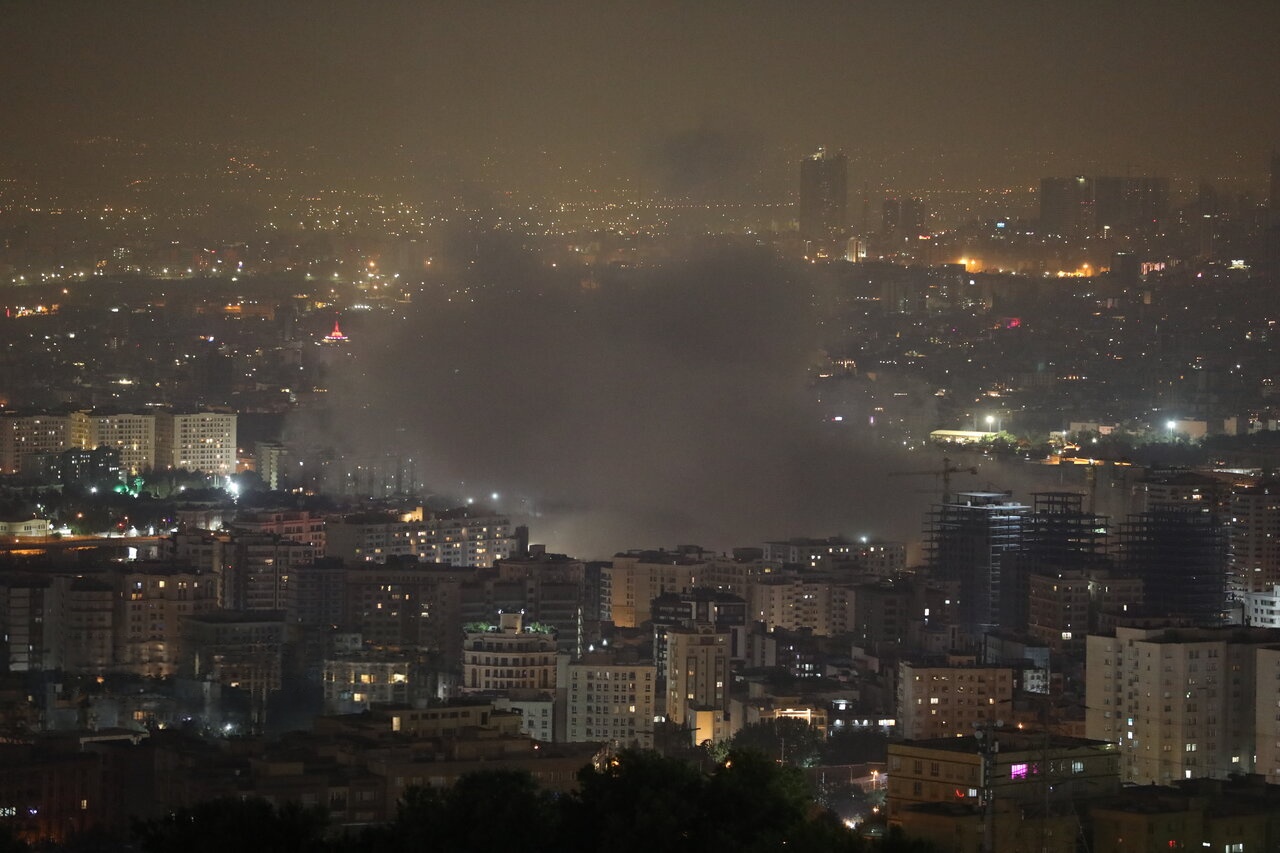
On 28 February 2026, as American and Israeli strikes began, President Trump told Iranians, “When we are finished, take over your government.” He told the Revolutionary Guard, Iran’s elite armed force, to lay down its arms and promised its members immunity if they did. Supreme Leader Ali Khamenei was killed in the opening strikes. Eight months earlier, American officials had said the aim of their strikes was narrow: “we don’t want to achieve regime change”. That was in the twelve-day war of June 2025, which killed more than a thousand people in Iran, according to Iran’s government and a rights group. A few days into the new war, in Tehran, a man crouched under his dining table and sent his friends what he thought might be his last message, asking them to forgive him.
The Men Who Ran Toward the Bombs
The first explosion came close enough to make the window seem to jump out of its frame. I heard the whistle, then the blast, then the screams. A moment earlier, I had been watching a television series with my cat beside me, purring. Now I was under the dining table, trying to understand what had happened, and she was nowhere to be found.
It was a few days into the second war (from February 28, 2026). During the twelve-day war (June 2025), my wife and I had left Tehran within the first few hours, taking our cat with us. This time, we stayed. We slept away from the windows, watched the flashes of air defences in the sky, and tried not to think too much about whether our home would still be standing in the morning.
Before noon that day, my wife was getting dressed to visit her aunt. She was wearing a navy blazer she had bought only a few days earlier. I remember thinking how beautiful she looked. I didn’t want her to go, but I told her not to worry. In those first few days, the explosions had mostly come in the late afternoon and continued through the night. We thought we had until four or five. We hugged and kissed goodbye. After the first blast, I kept returning to that moment, wondering whether it had been our last.
My wife called from several kilometres away. She had heard the blast. I told her I was under the dining table and couldn’t find the cat. She said she would come and get me. I begged her not to come into the neighbourhood. She went into another room and cried, then insisted. In the harshest voice I could manage, I shouted “You’re not coming here!”
Another whistle, another explosion, closer this time. The glass shattered. The house shook, and so did I. Still under the table, I opened our group chat with friends and typed: “If you’ve seen any bad behaviour from me over all these years, please forgive me.”
The alley outside was full of dust. I could barely make out the houses ten metres away. Car alarms were blaring. People screamed and shouted for help. Figures emerged from the haze, carrying whatever they had managed to grab and screaming as they ran.
I decided to leave. I called my wife and told her to meet me on the main road. I searched for the green backpack carrier I used for the cat. Someone shouted from the alley that a jet was coming again. “RUN!”. I ran back under the table. There was another whistle, another explosion.
I found the cat squeezed beneath the sofa, in a space she had never managed to get into before. Her pupils were wide, her body rigid. I put her in the green carrier, grabbed my black backpack with my laptop, and left.
The courtyard was covered in broken glass. The garage door hung crooked. I ran, thinking of my cat, my wife, my parents, all the things I had left unfinished.
In the alley, people were running in the same direction. I passed a woman covered in grey dust, standing motionless, her eyes wide open. Someone asked why she wasn’t moving. She didn’t answer. Her husband, I was told, had pulled her from the rubble and gone back to rescue their child.
For years, I had imagined that if I ever found myself in a situation like this, I would stop to help. In films and books, people run towards danger to save strangers. I had always assumed I would do the same. But I kept running. I was terrified. I wanted to live, and I was ashamed of how badly I wanted it. I avoided looking anyone in the eye in case they asked me for help.
Then I saw the men running in the opposite direction.
They were young, bearded men, heading towards the bombed buildings and the rubble. Some were trying to reach people trapped beneath the debris. Others carried water or helped the injured. I saw two of them embrace and cry in a place where I could barely bear to stand.
They looked like men I had spent years learning to dislike, men I associated with religious fanaticism and the political world I had opposed for much of my life. I didn’t know who they were. I didn’t know what they believed, what they had done before that day, or whether they survived the next strike. I understood that they were running towards the rubble to help, but I couldn’t know what drove them inwardly. Perhaps helping people was part of their work. Perhaps they saw it as a way to defend the religion or system they believed in. Or perhaps, in those moments, they simply wanted to reach people trapped beneath the rubble.
I cannot know. I saw them for only a few seconds. But those seconds stayed with me.
After approaching the experience from different angles over the months, I have found myself returning more and more to Camus and his idea of the absurd. War can destroy the familiar order of life in seconds. One moment, you are watching a comedy series; the next, you are under a table sending what you think might be your last message to your friends, asking for forgiveness. The missile was not looking for you. There was no explanation for why one person should survive and another should remain beneath the rubble.
Steven J. Heine’s work on the psychology of meaning gave me another way to think about this. When something unsettles our sense of who we are, we may try to make it fit what we already believe, or hold on to those beliefs more tightly. I wondered whether I was doing something similar with the men I had seen.
That day, I ran away from the bombs. The men ran towards them. Somewhere else, women in a car were hoping for more bombing.
I had flagged down a car on the main road, trying to get farther north. A black luxury car carrying several young women in fashionable clothes slowed beside me. I asked whether the area farther up had also been hit. They answered excitedly: yes, and they hoped it would be hit even more.
I understood the political hope behind their words. They were from a group who wanted the Islamic Republic gone, at any cost. For them, the hope of a different Iran has become bound up with Reza Pahlavi, the exiled prince, who openly supported the American and Israeli strikes from the first day, as if the country’s future could be entrusted to a single saviour. In that story, the destruction of the present can begin to look like the necessary price of a promised future.
I only remember their excitement, and how strange it was to hear it while people nearby were trying to find their families in the rubble.
My wife arrived a little later because of the traffic. She was still wearing the navy blazer, still beautiful, her eyes wet with worry. After a long embrace, she told me, her hands trembling, that she had vowed to help someone poor if I were alive. Neither of us, of course, really believes in higher powers. Later, I wrote to her that while she had been praying to be beside me, I had been thanking an imaginary God that she wasn’t there. Fear had made us wish for opposite things.
My cat usually makes a racket inside her backpack carrier, especially in a car. That day, she remained silent until night. I remember her silence.
One thing I know about myself now: I will not run towards a bomb except for these two beautiful creatures.
The men remain harder for me to understand. I cannot assume that their actions were free of political conviction, or that their convictions made the help they offered any less real.
We were all trying to live in a world that had stopped making sense. I ran towards safety for reasons of my own. The men ran towards the rubble. The women in the car wanted the destruction to continue, hoping it would clear the way for the future they imagined. My wife made a vow to see me again.
We don’t just try to survive. We also try to hold on to the stories we tell ourselves about who we are.
What the bombs did
The government did not fall. Within nine days of Khamenei’s death, his son Mojtaba had succeeded him. By late October, The Field’s background page reports, the US military was preparing options for renewed strikes, though no attack order had been given.
Alborz says no Red Cross or other rescue teams had reached the scene yet, but that plainclothes security forces patrolled the neighbourhoods around the clock, and that these were the men he meant: the closest representatives of the Islamic Republic that people could see. We cannot confirm who they were, and neither can he. But if they were part of the state’s security apparatus, the men who ran toward the rubble belong to the system the strikes were meant to bring down, the same state that has since arrested thousands of people.
Reza Pahlavi called the strikes a “humanitarian intervention”. How many Iranians share the women’s hope? Nobody can say, but two surveys taken after the twelve-day war show a country divided. A University of Maryland telephone survey of 1,000 Iranians in 2025 found that 52 percent said they trusted the authorities and 79 percent wanted a punitive response to violations of Iranian territory. A survey by the research group GAMAAN, run through the Psiphon circumvention network, of 30,372 literate Iranians in September 2025 found 44 percent blamed the Islamic Republic for starting the war. Neither is a fair picture: phone respondents may not speak freely, and GAMAAN’s respondents chose to take part.
The civilian cost was heavy. The rights group HRANA recorded 1,568 civilian deaths by 29 March, and Iran’s health ministry, as reported by the United Nations humanitarian office, reported more than 3,300 civilians killed by 10 April. The strikes did not free anyone from the government. By Amnesty International’s count, the authorities arbitrarily arrested more than 6,000 people from 28 February to its report of 28 May, and at least 39 people were executed on political charges, 16 of them protesters and ten accused of spying for the United States or Israel. The judiciary chief ordered faster prosecution of “foot soldiers and accomplices of the aggressor enemy.”
Iran did not need the bombs to repress its people, but the bombs gave it a ready charge. Officials now treat dissent as collaboration with the enemy, and Amnesty says they are using the war as cover. The pattern is older. After the twelve-day war, Human Rights Watch reported, a police spokesperson said about 21,000 people had been arrested in the context of the June fighting, including for online expressions of support for Israel’s attacks.
The strongest defence of the strikes is the nuclear programme: the June 2025 attacks badly damaged Iran’s enrichment plants. But in March the head of the International Atomic Energy Agency, Rafael Grossi, said the widespread assumption was that Iran’s stock of uranium enriched to 60 percent, a short step from weapons grade and about 440 kilograms before the June 2025 attacks, was still there, mainly at Isfahan. If that is right, the attacks did not remove the material that the programme’s defenders point to.
This year’s stated aim depended on a particular kind of Iranian: one who stays home until called, then turns on the government, while the men with guns lay them down. Alborz’s street was less tidy. Some people ran towards the rubble, some hoped for more bombs, and one man ran away and was ashamed of it. Three moments in one city prove nothing about a country. That is the point. What the bombs have done is on the record: the government still stands, at least 1,500 civilians are dead, and more than 6,000 people have been arrested in the name of the war. That is why “I cannot know” is the most reliable sentence in this account, and the promise that bombs would free a people the least.
What to watch. Whether the United States acts on its options for renewed strikes, whether the arrests and executions Amnesty counted continue, and whether Iran's authorities answer our questions.
Comments
Every comment is read by a person before it appears, so yours will not show straight away. We publish comments that are civil and on the subject. To report a mistake in the piece, use the corrections page, so it is fixed in the piece itself.