Editor’s Note: Abdulkadir Isse reported this from Nairobi. The opening scene is his own reporting, from interviews with residents who are not named; the account of the recording is The Washington Sun’s, credited where it is used. I edited the piece for The Field and checked each figure against its source. On 8 November I asked the Treasury, Agriculture and Justice departments for comment. None had replied when this was published, and any reply will be added here. I found no press contact for the White House; its statement to the Sun is carried in the piece.
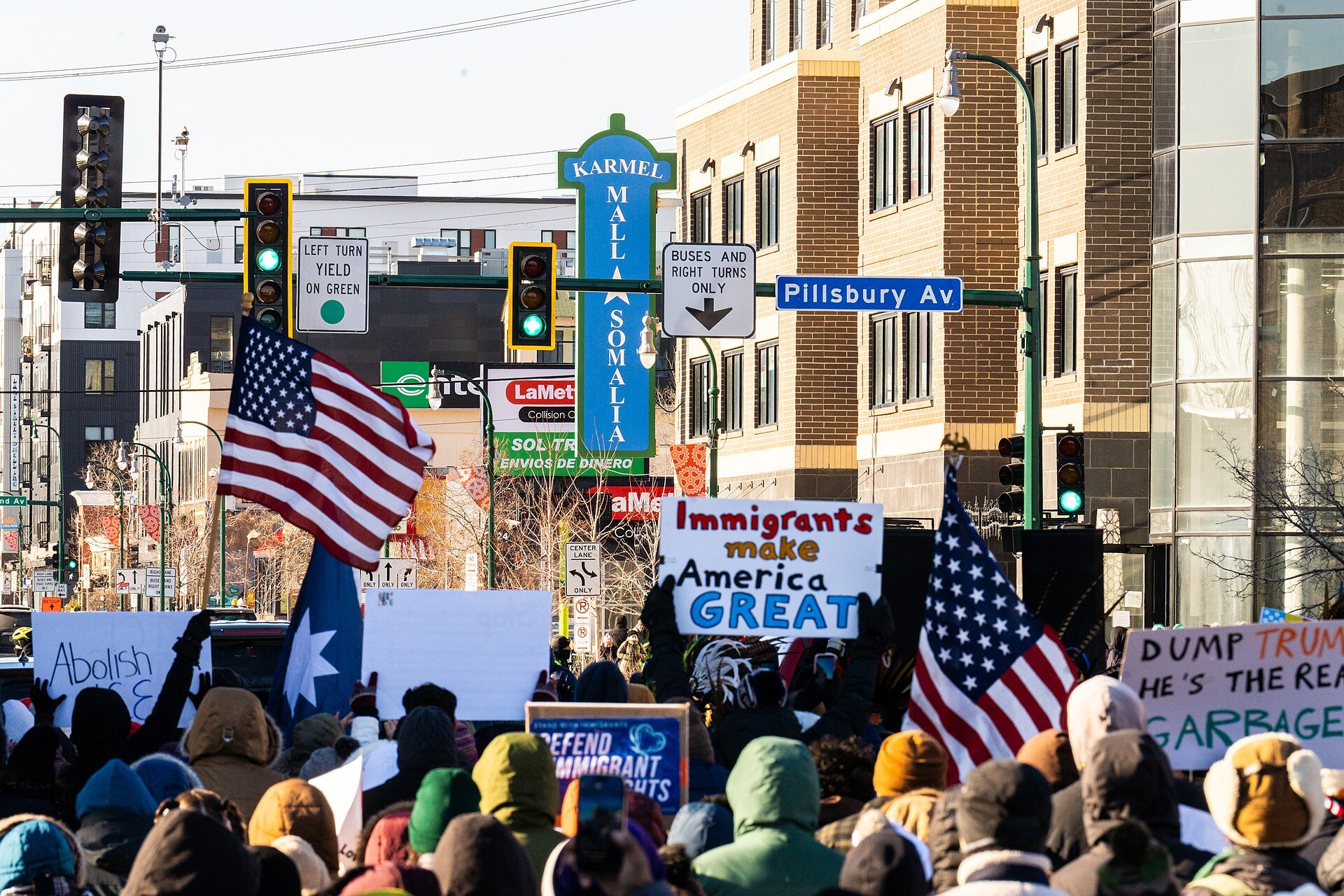
Inside a community daycare in South Minneapolis, toddlers now play under the eyes of private security guards the centre had to hire after armed federal agents began sweeping the streets around it.
The agents came in part over fraud allegations at daycares. On 26 December a conservative YouTuber, Nick Shirley, posted a video alleging fraud at Minnesota child care centres, and within weeks the president had created a new fraud division at the Justice Department, the Washington Sun reports. What followed reached far past any one centre, and a recording reported this week shows, according to the Sun, who was driving it.
The Sun obtained a recording of a telephone call from December 2025 and reported on it on Friday, 6 November. According to the Sun, Stephen Miller, then White House deputy chief of staff, pressed officials for evidence of fraud tied to immigrants, Minnesota and Somalis nine times in about ten minutes. When an official began to describe fraud in Florida, the Sun reports, Miller cut the official off. When he was told that federal prosecutors in Virginia were running an active national fraud investigation, he answered, “I hear you, but that’s a long way off from Minneapolis.” A source close to the White House told the Sun the campaign was “like a passion project for him.” Administration officials told the Sun the focus was a specific population of immigrants rather than fraud in general, and one called the campaign “inane.” The White House said the call was focused on rooting out fraud in Minnesota, and that there is no denying the Somali population was a large part of the fraud there.
The same Friday, Trump named Miller his chief of staff, a post Susie Wiles has held since the start of his second term, and he started the job on Monday. That is the question this piece asks: what happens when the official who steered a federal campaign against one community now runs the whole executive branch, and does the evidence he relied on bear the weight? The record already answers the first half. The fraud was real. The campaign built around it was aimed at a place and a people, and where judges have looked at parts of it, on food aid, child care money and ballots, it has so far lost.
The fraud was real, and the response did not fit it
No honest account can pretend the crimes did not happen. Feeding Our Future, a nonprofit that claimed to feed children during the pandemic, took in about $250 million in fraudulent federal money, according to the Justice Department. Its ringleader, Aimee Bock, was sentenced on 21 May to 500 months in prison, about 41 years, and ordered to repay nearly $243 million, CBS News reported. Dozens of others have been convicted. In May federal prosecutors charged 15 more people in schemes they said targeted $90 million in Medicaid, the public health insurance programme for people on low incomes, and other programmes. The Associated Press, citing the US Attorney’s Office for Minnesota, counted 92 defendants charged in these schemes against social-services programmes, 82 of them Somali American. Those are real crimes with real defendants, and a government is entitled to chase them.
The prosecutors’ own estimate is larger still. In December Minnesota’s top federal prosecutor at the time, Joe Thompson, said 14 programmes had been identified as containing fraud, that they had paid out about $18 billion since 2018, and that “half or more” of it might have been stolen, adding that the exact figure was still under investigation. That is a projection, not a count of charged cases. The defenders of the crackdown will rest on it, and they are right that it is serious. But look at the shape of what it describes: schemes run by identifiable people through identifiable organisations, charged one defendant at a time.
Set that beside the other number. Roughly 100,000 Somalis live in Minnesota. About ninety defendants is a small share of a population that size, and fraud is not a Minnesota story alone. The Government Accountability Office, Congress’s auditor, estimates the federal government loses between $233 billion and $521 billion to fraud across the country every year. The Sun describes Florida as a hot spot, and on the recording Miller waves it off, as he waves off Virginia. Linda Miller of the Program Integrity Alliance, who spent a decade working on fraud at the Government Accountability Office, told the Sun there is an actual fraud problem in Minnesota, but that it is not a fraud problem related to immigration. A campaign that followed the money would follow it to Florida. This one followed it to Minneapolis, and then to the people who live there.
One method, many targets
Starting in the fall of 2025, Miller’s directives reached at least five federal agencies, the Sun reports. At Treasury he pressed officials to examine Minnesota bank reports, and the department then ordered banks and money-transfer firms in Hennepin and Ramsey counties, the Minneapolis and St Paul area, to report transfers of $3,000 or more sent outside the country, with exemptions for some banks and large institutions. Treasury aides, some of them Trump appointees, pushed back, the Sun reports, saying the order would not catch the suspicious payments between government agencies and Somali-run nonprofits. Staff also worried it could cross constitutional limits on sweeping searches. The order was narrowed earlier this year to exempt some banks and renewed in August for another 180 days. It covers ordinary customers who send that much abroad, whether or not anyone is accused of anything, and Somali business owners told the Sun it caused panic about their ability to send money home.
At the Agriculture Department, Miller’s team pushed to cut up to $150 million in funding, including food assistance, and Secretary Brooke Rollins demanded that about 106,000 households in four counties on SNAP, the food stamp programme, be recertified within 30 days. In January a federal judge, Laura Provinzino, barred the department from withholding the money while the case went on, finding that it had given no well-reasoned explanation of how the demand would help assess fraud. At the Centers for Medicare and Medicaid Services, the federal health-insurance agency, Minnesota was told in December to file an anti-fraud plan or risk losing money, and Administrator Mehmet Oz said he would withhold up to $2 billion a year. Not every court stopped this one: in April a federal judge declined to block the agency from holding back roughly a quarter of a billion dollars in payments, according to Minnesota’s human services department, which is appealing. And the federal child care agency, part of the Department of Health and Human Services, froze funds for Minnesota and four other states, courts blocked the freezes, and the department later lifted them.
Then came the street. Thousands of federal officers were sent into Minnesota, and in January federal agents killed two US citizens, Renée Good and Alex Pretti. The surge ended in February. The Sun says the administration partly justified it by pointing to fraud, and it quotes Gregory Bovino, a former top Border Patrol official who left after the shootings. Speaking about Minnesota, he said, “We should have doubled down and hit that community even harder,” and argued that fighting fraud requires mass deportations. Fraud is a crime that a court can prove or fail to prove. Deportation is a remedy for who a person is. The two are different kinds of answer, and the second does not need a defendant.
The method did not stay in Minnesota. In the weeks before the election the Justice Department demanded that states set aside mail ballots from people it called likely noncitizens, up to 20,000 in California and 405 in Washington state, and in both places officials found serious problems with the lists. Judge David Carter denied the department’s request for an emergency order in California on 28 October, writing that the way the federal government matched names to its records raised significant concerns and that he could not conclude it was credible. An early Los Angeles County review found many people on the list had no active registration, and a federal immigration official acknowledged that four of those reviewed might have a claim to citizenship. In Washington, Secretary of State Steve Hobbs said the list, built from interviews with immigration agents and questioning at the Canadian border, included citizens, duplicate names and people who were not registered, and arrived about a week before the vote as a printed spreadsheet with no addresses; his office noted that one record on it dates to 1994. As The Field reported before the vote, the California suit looked weak in court but could still do harm. The day before the election the same message reached Ohio, where the vice president told a rally that “illegal immigrant Somalis” were coordinating to flood the polls, and the fact-checking group NewsGuard could not find any such story. Voters answered at the ballot box: Ilhan Omar won her fifth term with 76.5 percent, and, by unofficial returns, eight Somali Americans won seats in state legislatures, as The Field has reported.
The pattern across the agencies, the surge and the ballots is the same. A list or a label stands in for evidence, a deadline leaves no time to check it, and the cost lands first on people no one has charged. That is what a campaign looks like when it is aimed at a population. A case looks different. A case has a defendant, a document and a judge, and its cost lands on the person who committed the crime.
What happens now that he runs the White House
The campaign’s defenders have a point they will make loudly, and it deserves its full weight: a government that finds theft owes taxpayers a response. The White House says the president has zero tolerance for it. Oz told the Sun that Miller was less involved than other members of the White House fraud task force. Colin McDonald, who leads the new Justice Department fraud division and was sworn in in April, said the department’s work in Minnesota is only beginning and will continue as long as it takes. Those statements are fair, and a reader should hold them against the recording.
But the answer the record gives is about proportion and method, not about whether to prosecute. Where a case is strong, prosecutors do not need a community-wide freeze to make it; Bock’s 41 years came from a trial. Where a case is weak, a freeze does the punishing before any court can look. Carter said as much in California: if noncitizens vote, the government can prosecute them one by one. And where courts have looked at the food-assistance order, the child care freezes and the California ballot demand, they have so far sided with the states. The Medicaid payment hold and the bank-reporting order are still standing, and the judge in the Medicaid case ruled that the state’s challenge was premature, not that the hold was justified.
The hard questions follow from that record, and the record does not yet answer them. If the aim was fraud, why did the official steering the effort wave off a bigger case in Virginia and the fraud the Sun says is also found in Florida? What has the Treasury reporting order caught, when Treasury’s own aides warned it would miss the suspicious payments between government agencies and Somali-run nonprofits? Why did a former Border Patrol official say Minnesota should have been hit “even harder” and call for mass deportations, and what fraud case needs a deportation to be proved? And if the campaign was never aimed at a people, why did administration officials tell the Sun the focus was a specific population of immigrants rather than fraud in general?
What changes now is who sits closest to the president. A chief of staff decides who reaches him and what lands on his desk, and the man who pressed officials on that call about Somalis will make those decisions. The check on him is mostly outside the White House. The courts have already stopped parts of the campaign. And when the new Congress takes office in January, Democrats will hold the power to subpoena, NPR reports, with hearings on violence by immigration agents already on their list, an issue NPR links to the killings in Minnesota. NPR’s account does not say they plan to look at the fraud campaign itself, and that is the gap this piece leaves open. As MPR News reported, the Sun’s reporter says her reporting does not establish why Miller focused on Minnesota, and that is the honest limit of what the record shows. Whether the campaign was aimed by data or by design is the question the recording raises. The proportions, the waved-off investigations and the tools that reached the uncharged all point to design, and only an inquiry with the power to ask for the documents can settle it.
Back at the daycare in South Minneapolis, the guards stand at the door because the families who use it have been told, loudly and for a year, that they are the problem. A fraud case ends with a verdict. A campaign against a community ends only when someone with the power to stop it decides to, and the children on that floor are waiting to find out who that will be.


Comments
Every comment is read by a person before it appears, so yours will not show straight away. We publish comments that are civil and on the subject. To report a mistake in the piece, use the corrections page, so it is fixed in the piece itself.