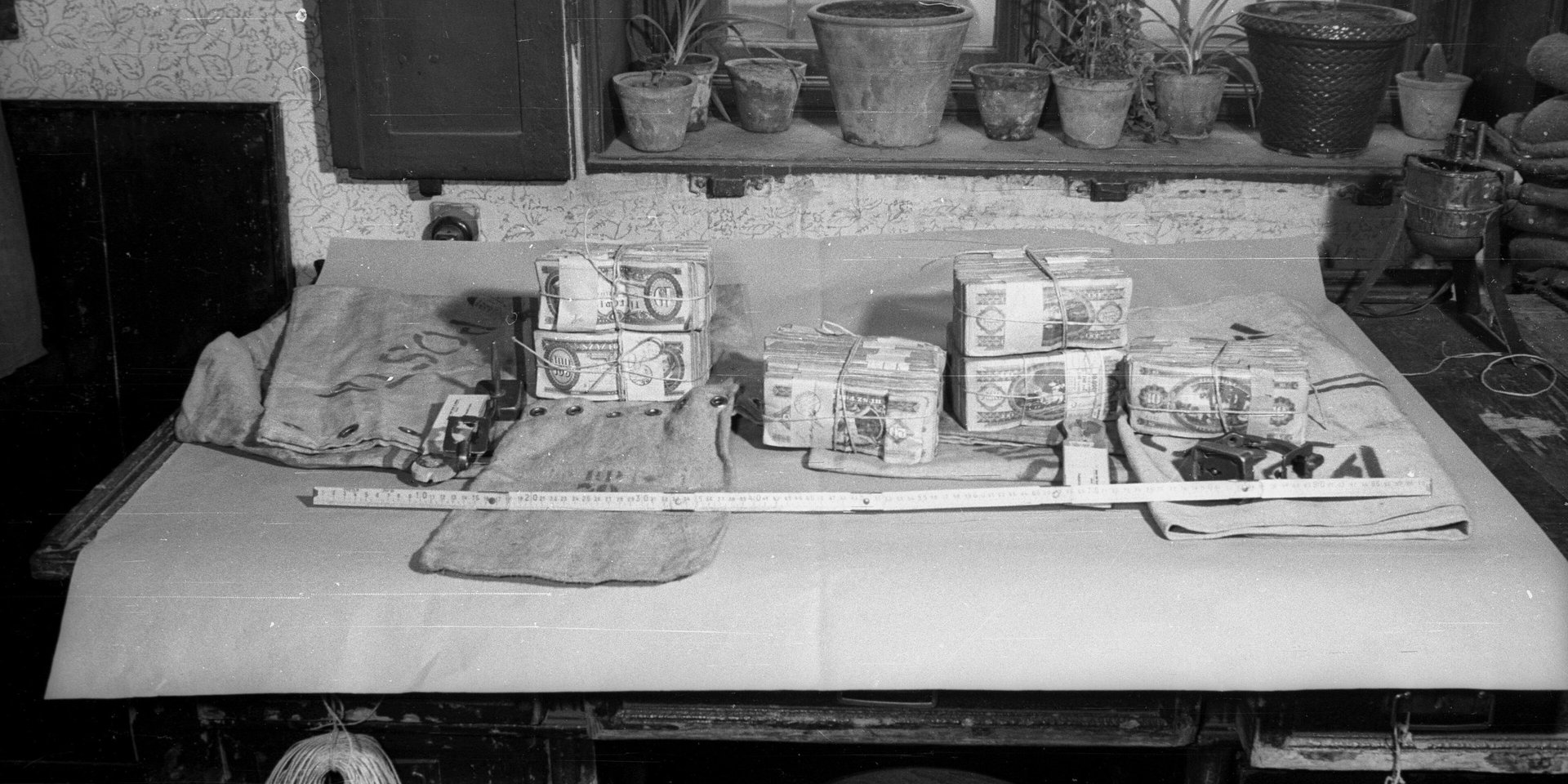
The photographs show investigators digging through a rain-soaked Hungarian forest and lifting out bundles of cash. The National Asset Recovery and Protection Office (NVVH), a new agency, released them late on Friday. Over two days its officers searched sites across the country and recovered nearly 6.5 billion forints, about $20 million. Reuters reports that some of it was buried in forests, some hidden in farm buildings, warehouses and a residential property, and some kept in a high-value safe in a secluded place. Finance Minister András Kármán said a dozen State Treasury employees needed eight hours to count it.
The case is a bribery investigation into Miklós Seszták, who was national development minister under Viktor Orbán from 2014 to 2018 and is now a Christian Democrat member of parliament. He has denied wrongdoing. He was taken into custody on 28 September, and a court ordered him held two days later. On 28 October the investigating judge of the Buda Central District Court extended his detention to 30 January, finding the prosecutors’ concerns about flight and about the evidence well founded and rejecting his defence’s requests to end it or to release him on bail. The investigation is tied to the state bus operator Volánbusz. Earlier, investigators went looking for nine billion forints in cash and found two empty safes in an office building in Kisvárda linked to him. The nine-billion figure rested on a suspect’s confession and a sniffer dog’s indication. Seszták denied it, and the dog’s evidentiary value is disputed.
The politics have moved fast. Prime Minister Péter Magyar, who ousted Orbán in April after 16 years, said the discovery marks the end of what he calls a mafia run by Fidesz and its Christian Democrat allies. Fidesz, in a statement from press secretary Bertalan Havasi in reply to Telex, said it cannot associate with anyone who breaks the oath to uphold the law and hoped the pictures had nothing to do with Seszták. The Christian Democrats’ parliamentary leader, Bence Rétvári, told Seszták to give up his seat, as did Fidesz group leader Zsolt Bóka, while Rétvári also warned that Magyar wants to paint the whole right as criminal. The anti-corruption drive carries the name Operation Purgatory.
Politically, then, the cash may be decisive. Legally, it proves little yet, and the most revealing statement in the story came on Sunday. NVVH president Anna Unger was asked on RTL whether this is Seszták’s money. She said no one knows whose it is and that it will be decided later. She also said the properties where the money was found do not necessarily belong to him. She would not say whether the 6.5 billion forints are part of the nine billion investigators were looking for earlier. She did say the serial numbers suggest the notes are not freshly issued. Seszták’s lawyer, Gábor Papp, told the news site Telex, “This is not my client’s money,” and that the case has several suspects besides Seszták. So the strongest evidence in the public mind is, for now, a pile of cash that no court has yet tied to anyone.
On Monday Unger added detail in a Kossuth Radio interview. She said investigators found the money using information gathered inside this criminal case, not from an outside tip, and that officers recorded DNA traces on the packages, with the results due later. The prosecutor general’s request to lift Seszták’s immunity alleges that he and Norbert Szivek, then chief executive of the state asset manager MNV, took more than 11 billion forints in unlawful advantage through intermediaries between 2015 and 2018, from the representative of companies that held contracts with Volánbusz. Unger said the case will not rest on who handled the notes, because many people did, and she rejected suggestions that a state body buried the cash or that it is play money. Tibor Navracsics, a former Orbán-government minister, answered that the agency must prove the link to Seszták, and Bence Tuzson, a former justice minister, called the story fairy-tale-like and disputed the legality of the Treasury deposit. None of this is yet proof in a courtroom, but it shows where the prosecution intends to look.
That gap is the weak point, and everyone in the story has a reason to widen or narrow it. The government gains from the pictures. Fidesz gains from doubt. Orbán has called such investigations political persecution, and his brother is held in a separate people-smuggling case that he has described the same way. And Seszták’s defence gains from a question that cannot yet be answered.
There is a fair way to read the case that needs no side. Large sums of buried money are hard to explain, and a country with a record of closed-door state contracts is right to want them traced. But cash must be tied to a person by something other than where it was found. Courts accept records that link money to its owner and witnesses who repeat their statements in front of a judge. They do not accept a photograph, however vivid.
What would make this credible, to Hungarians who voted for Orbán as much as to those who did not? First, a public accounting of the money, with the agency saying what ties each batch to a suspect and what it does not. Second, a trial rather than a campaign. A government whose popularity rises with each arrest is tempted to keep announcing them, and the best protection against that is a court that can acquit. Third, the same standard for anyone near Magyar’s own coalition if allegations arise. An anti-corruption drive that finds only the previous government’s friends will earn the suspicion Orbán wants to attach to it.
For now, Hungary has a striking image, a detained former minister, a rattled opposition and a pile of money that officially belongs to nobody. The forest gave prosecutors a picture. Only a courtroom can turn it into a verdict.
Comments
Every comment is read by a person before it appears, so yours will not show straight away. We publish comments that are civil and on the subject. To report a mistake in the piece, use the corrections page, so it is fixed in the piece itself.