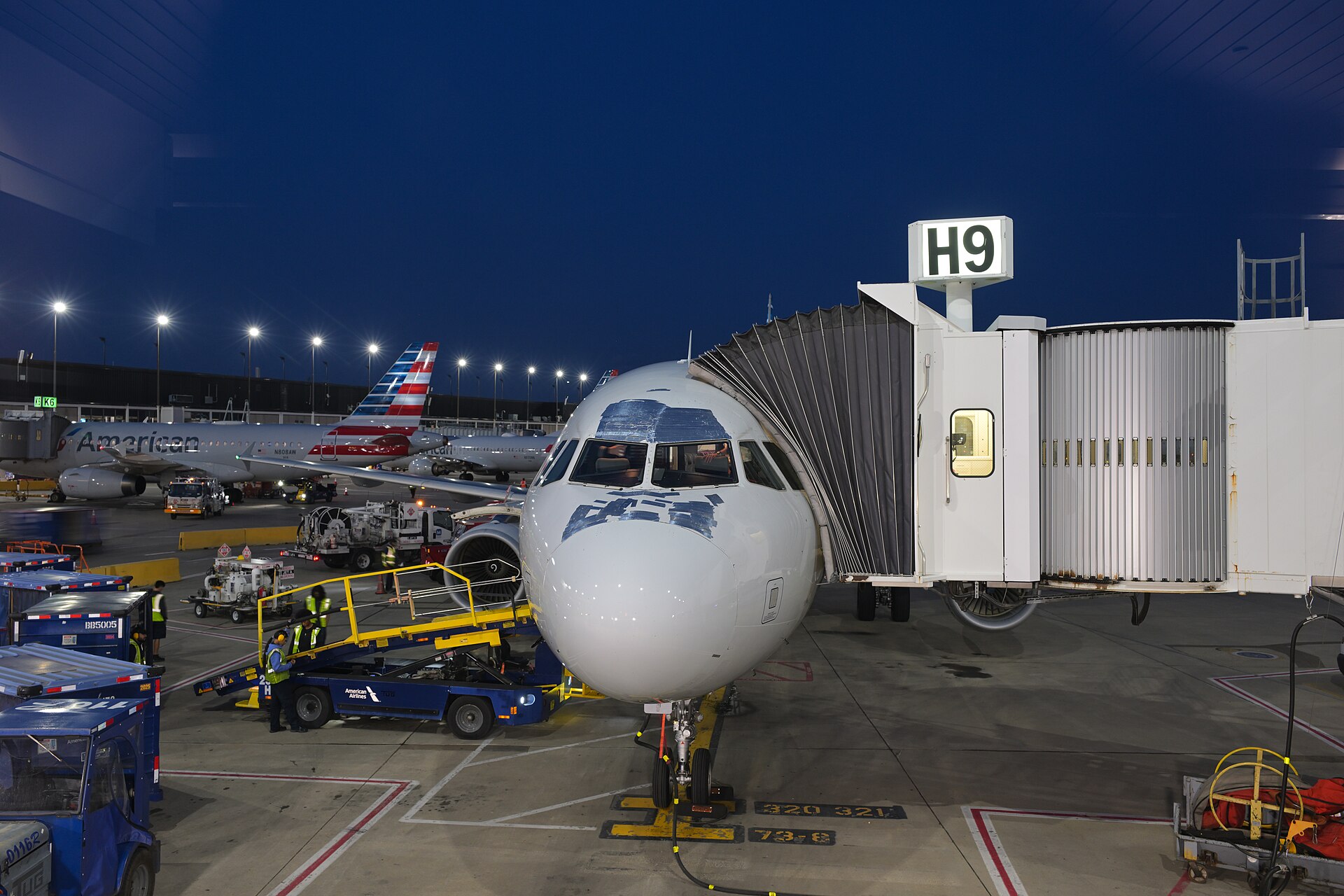
At Ronald Reagan Washington National Airport on Friday, passengers waited onboard a plane. At Boston’s Logan International Airport, passengers looked at the departure and arrival boards, and the airport said the stop was affecting flights there and at airports across the country. At Chicago’s O’Hare, the terminal was filled with waiting passengers. A fault in the country’s air traffic communications had reached the places where millions of people depend on it.
Shortly before 4 p.m. Eastern time, the Federal Aviation Administration sent every airport in the United States the same order: all departing traffic should remain ground stopped until further notice. Nothing could take off, which is what a ground stop means. Planes already in the air were allowed to carry on, and flights arriving from abroad would be handled one by one. Departures to other countries did not stop entirely: flight-tracking data cited by Fox Business showed some international flights leaving Logan, Dulles and Los Angeles for Rome, Frankfurt and Shanghai. Transportation Secretary Sean Duffy said the cause was a communication problem affecting all 22 of the regional centers that guide planes between airports.
By 6:04 p.m. Eastern time, the flight-tracking service FlightAware had counted 1,913 cancellations and 10,494 delays, and the numbers were still climbing. The FAA lifted the order about four hours after it began, CNBC reported, but cancellations were expected to run into the weekend. Homeland Security Secretary Markwayne Mullin called the cause a telecommunications outage and said there was no indication of a nefarious attack. Asked about a cyberattack, he said the government was not ruling anything out and that, for now, it was not known.
That answers the question everyone asked first. It does not answer the one that matters more. If nobody attacked, then a communications failure still stopped every departure in the largest aviation market in the world. This piece argues that “no attack” is the harder finding, not the easier one. An accident that can ground a country shows that something in the system is shared, fragile or never tested, and a weak point that was found by accident can be studied by anyone. It also arrives seven weeks after the federal government’s own watchdog documented unfinished security work on aviation communications. Nothing yet connects the two. The public is owed an explanation of why there might not be a connection.
What the stop was, and what we do not know
The FAA’s order was a precaution, not proof that aircraft were in danger or that controllers had lost contact with every pilot. Stopping new departures when the network cannot be trusted is what a safety agency should do, and the FAA deserves credit for choosing caution. The failure, if one is established, lies in whatever made so sweeping a precaution necessary.
On that, the public record is thin. As of the reporting available when this was written, officials had not said what failed inside the communications network. They had not said whether all 22 centers suffered the same fault or whether one shared service they all depend on went down, whether voice radio, data links or the lines between controllers were hit, or why the backups did not keep departures moving. A backup only helps if it does not depend on the thing that broke. Two separate machines that run on the same telecommunications provider, the same software setting or the same power feed can fail together. There is no public evidence that this happened on Friday, and investigators have to establish whether it did before anyone is blamed.
What the FAA can give the public without handing a map to attackers is a timeline: when the problem was first detected, which services it touched, when the stop was ordered and what had to be true before flights could resume. Mullin’s reassurance was an early reading, not a finished investigation. A timeline would turn it into one.
There is also a plain security question here, and it is not an accusation. If an accident can disrupt national aviation, what would prevent a deliberate attempt from producing the same result?
The warning from September
On 21 September the Government Accountability Office, Congress’s watchdog, published a report titled Aviation Cybersecurity: Enhanced Air Safety Requires FAA to Better Mitigate Threats to Aircraft Communications. It found that the FAA had identified threats such as jamming, which drowns out a radio signal, and spoofing, which sends false signals, but had not finished its risk and mitigation assessments, and that its security paperwork for some systems needed updating. It also found that the agency had no defined, real-time way to watch for all such threats, so it could generally investigate only after an incident was reported. The report said two messaging systems that pilots and controllers use alongside voice radio, known as ACARS and CPDLC, can be intercepted or faked because of weak identity checks and encryption, and that a bad actor could send a false order cancelling a clearance and cause delays or safety problems.
The GAO made nine recommendations. The Department of Transportation agreed with all nine, and the GAO’s page still listed all nine as open when it was checked on 13 November. That does not mean the FAA has done nothing. It means the watchdog has not yet recorded that anything was finished.
The report does not say it explains Friday. Its subject was communications with aircraft, and nobody has said that the failure involved those links. But the report puts a fair question on the table, and officials should answer it directly: which of the assessments and monitoring tools the GAO asked for were in place on Friday, and was any system it examined involved? If the answer is no, say so. If the answer is yes, the public should learn whether the stop could have been prevented or contained.
Money, a new system and an old lesson
Congress approved about $12.5 billion last year to modernise air traffic control, and Duffy says another $30 billion is needed. Spending is not the same thing as safety. The question for lawmakers is narrower: which parts of the communications network that failed have been replaced, which still run on old equipment, and has anyone tested whether a fault at one center can spread to the others?
The timing also drew attention to SMART, a software tool the FAA expanded to all 22 centers on 10 November, three days before the stop. SMART suggests routes and schedules from many streams of data, and controllers decide whether to accept its advice. Its developer, Air Space Intelligence, said the ground stop was not caused by its system, and neither the FAA nor Duffy has linked the two. Blaming new software without evidence would be wrong. But a tool that went nationwide three days before a nationwide stop is a reason for the FAA to say plainly what SMART can touch and whether it can be switched off without affecting anything else. What testing is required before a tool like this goes nationwide, which other systems can it reach, and can its changes be undone?
Friday was also the first nationwide ground stop since January 2023. That time, the FAA said contract staff unintentionally deleted files while fixing the link between a main database and its backup, and found no evidence of a cyberattack. The two failures involved different systems. They share a pattern: an ordinary fault, or an ordinary repair, spread much further than the equipment it started in. The test of the FAA’s work after 2023 is whether the lesson was applied beyond the one system that broke. Were national-level failure scenarios tested afterwards, and were the requirements for backup services tightened?
Europe offers a different warning. In September 2025 a ransomware attack, in which criminals lock a company’s files, on Collins Aerospace, a supplier of check-in and boarding software, disrupted Heathrow, Brussels and Berlin airports, the EU cybersecurity agency confirmed. That was a passenger-processing system, not air traffic control, and nothing links it to Friday. It does show how one outside provider can slow many airports at once. The FAA should say whether any outside provider sat behind Friday’s failure, and whether such providers must prove that their backups work. Who is accountable when a private service becomes essential to public aviation safety?
What Congress should demand
The fees airlines waived cover only the cost of changing a ticket. Delta waived change fees for Friday and Saturday, and United for travel between 12 and 20 November. They do not cover a missed event, spoiled cargo or a lost workday, and the cost of a failure in a public system should be part of the investigation, not an afterthought.
Lawmakers have two jobs. One is to keep the money moving toward better equipment. The other is to ask for proof that it is working, and the two should not be confused. They should require the FAA to publish its timeline, report progress on each of the GAO’s nine recommendations, and say whether a fault at one control center can spread to the rest. They should also ask for an outside test of that question. Neither side should treat the matter as a contest in which more funding is the only answer or government waste explains everything. Both claims need evidence.
The response depends on the cause. A broken piece of equipment needs engineering. A software error needs a fix. An attack needs a security investigation. A resilient system can tell which of the three it faces without letting its uncertainty stop the country’s planes.
The government says there is no sign of an attack, and that may prove true. But ruling out an attacker does not explain why a communications failure could stop departures across the country, what was supposed to prevent it, or what will change before the next one. The 2023 stop, the September warning and the billions already committed all point to the same conclusion: the weakness is not one broken part. It is the distance between what the government knew and what the system could withstand on a Friday afternoon.
There is a deeper point here. The United States has the most powerful military and the largest economy in the world, and still one communications failure was enough to keep every plane on the ground. Power on that scale is supposed to include the ability to see weak points before they fail. The government had been warned about the kind of weakness, in September and in 2023. A country of 350 million people is right to expect that a warning like that leads to fixes before the next failure, not after it.
And if Washington cannot explain what failed, what safeguards were supposed to prevent it and what will change before the next disruption, how can the public know that the next warning will be followed by more than another nationwide ground stop?
What to watch. Whether the FAA publishes a chronology of the failure; whether it says if any system the Government Accountability Office reviewed was involved; and how many of the watchdog's nine recommendations are closed by the end of the year.
Comments
Every comment is read by a person before it appears, so yours will not show straight away. We publish comments that are civil and on the subject. To report a mistake in the piece, use the corrections page, so it is fixed in the piece itself.