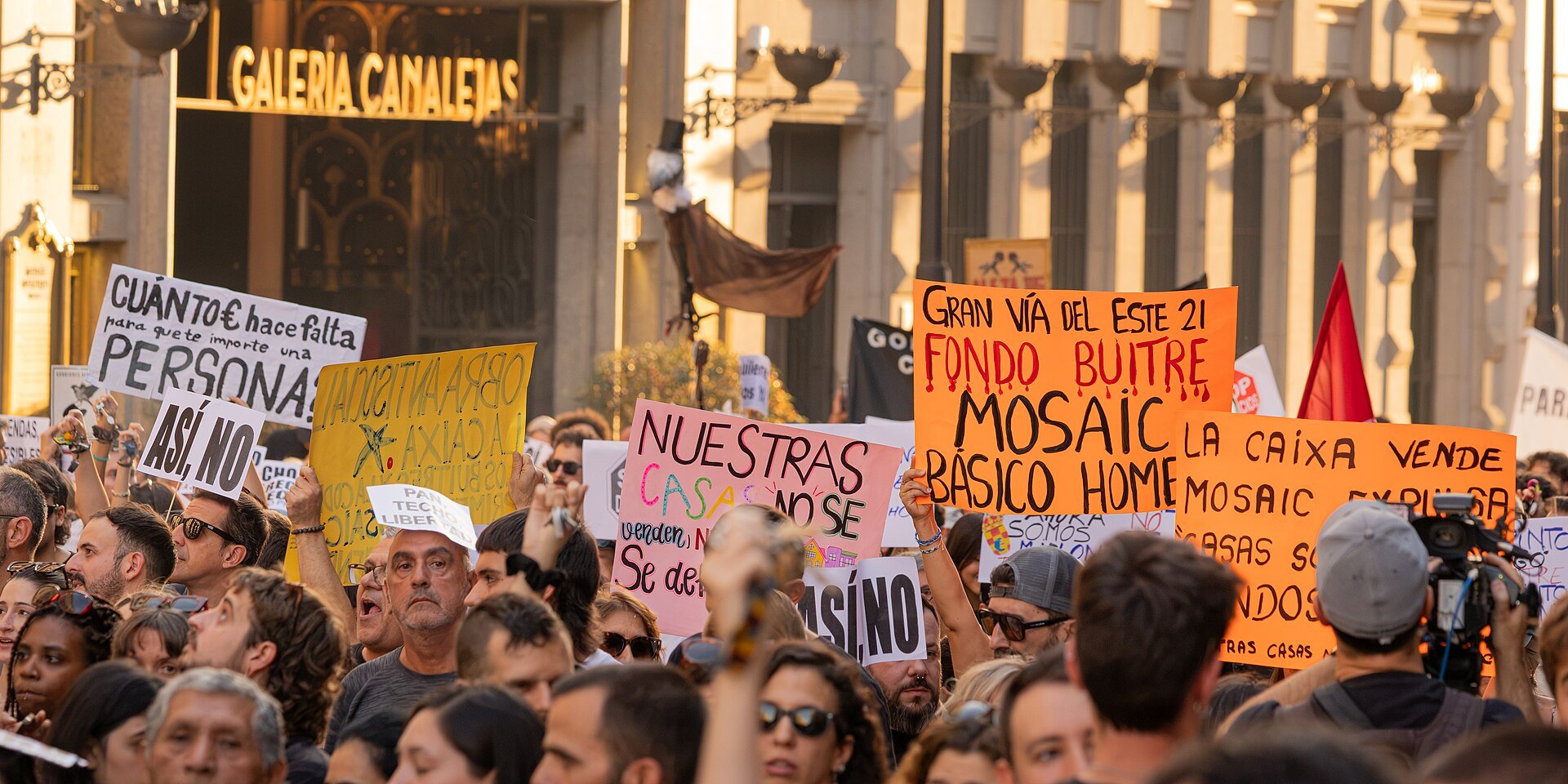
On Madrid’s Gran Vía on Wednesday 11 November, protesters shook sets of house keys above their heads and chanted that they were going to close the Mango store. Reuters described shop after shop pulling down its shutters, Primark, H&M and Pull & Bear among them, with riot police close by. Spain was in its first general strike since 2012. Its subject was not wages or pensions alone, but the cost of a place to live.
How many people took part is the first thing in dispute. The Tenants’ Union, which pushed for the strike, put turnout at about four million people in its 1 p.m. balance. The big unions, CCOO and UGT, reported participation of between 41 and 75 percent at 7 a.m. and called the day a success. The employers’ confederations, CEOE and Cepyme, put average participation below 5 percent. Nobody’s number is independent. What can be checked is smaller and sturdier: according to the grid operator, Red Eléctrica, electricity demand at noon was about 12.7 percent below the previous Wednesday, though the gap narrowed to roughly 2.4 percent by 6 p.m. That is a real dip, but a shallower one than organisers hoped for, and the Tenants’ Union says production stopped entirely at the SEAT plant in Barcelona and Volkswagen’s factory in Navarre. The day was not peaceful. Police counted 653 incidents and more than 40 detentions in the final Interior Ministry tally, and CCOO and UGT said they would study legal action over police charges at Madrid depots, where at least 13 people needed medical care.
The reason people were angry is easy to find. The Bank of Spain estimates the country is short of about 750,000 homes, a gap that could pass one million by 2028. The Youth Council of Spain says the average rent, €1,176, equals 98.7 percent of a young person’s average monthly salary.
The spark was a person, not a statistic. Maricarmen Abascal, 87, was carried out of the Madrid flat where she had lived since childhood on 23 September, on the fourth attempt to remove her. Its owner, the investment fund Urbagestión, had demanded rent increases she could not pay. Cameras caught the eviction. Tens of thousands marched, and activists set up a camp in the Puerta del Sol. Urbagestión later agreed to let her return, but she never did: she had been in hospital since the day of the eviction and died there on 7 October. Protesters carried signs reading “Not even one more Maricarmen.” She is unrelated to Vox leader Santiago Abascal.
Then politics took over. Pedro Sánchez’s minority government approved two emergency housing decrees, and on 2 October Congress rejected them, with the People’s Party, Vox and Junts voting against the first decree. On 5 October Sánchez called a snap election for 29 November. The unions, with the Tenants’ Union pushing for it, called the strike, and the government supported it. His Socialists trail in almost every poll, according to the property portal idealista. The exception is the state pollster CIS, whose pre-election survey, published on 12 November from interviews held between 7 and 30 October, projects 134 to 143 seats for the Socialists and no majority for the People’s Party and Vox, who would reach 171 at best, five short of the 176 needed. The People’s Party, Vox and some political scientists have questioned the CIS’s method.
Housing is also competing for attention. On 28 October a high-speed train collided with a stationary one south of Madrid and killed 69 people, and Transport Minister Óscar Puente resigned in early November, AP reported, complicating a campaign Sánchez had wanted to fight on rent.
That is the second thing worth stating plainly. The strike was real, and so was the timing. The opposition questioned the date and suggested it could influence the campaign. The government’s answer is that the crisis is real and the decrees were rejected before the campaign began. Both can be true. What a voter can fairly ask is which side is offering something that would put homes under roofs.
The Thursday vote after the strike answers part of that. With parliament dissolved, a 69-member caretaker body decides on decrees. It ratified the first decree 35 to 34, with the Basque PNV holding the deciding vote. That decree extends eviction protections for tenants whom social services judge to be in a precarious position. The second decree, which would have made rental contracts renew automatically, failed by the same margin the other way, once the PNV joined the People’s Party, Vox and Junts. The PNV’s leader, Aitor Esteban, gave two reasons: that the decree attacked small landlords and that it would shrink the supply of rentals. The decrees last only as long as the next government allows, and the outcome of the vote on 29 November will decide that.
Beneath the vote count is supply. Everyone in the argument agrees there are too few homes. The government says it will intervene in the market “with the full force of the law” if it wins. The People’s Party leader, Alberto Núñez Feijóo, promises three housing laws within 100 days, including removing squatters within 48 hours and tax breaks for landlords who keep rent rises below inflation. The employers’ side, speaking through CEOE vice president Ángela de Miguel, says the answer is to build more and cut taxes on construction. Each camp is partly right. Rent limits protect existing tenants and may shrink the rental stock, and a building boom takes years the evicted do not have.
A fair test for whoever wins on 29 November is whether they can do both: protect people now, and get far more homes built. A strike can force a government to listen. It cannot lay bricks. Spain’s young people have shown they will stop work for a home. Whether anyone will answer them with one is still open on election night.
Comments
Every comment is read by a person before it appears, so yours will not show straight away. We publish comments that are civil and on the subject. To report a mistake in the piece, use the corrections page, so it is fixed in the piece itself.