
Outside an off-campus apartment shared by Black University of Mississippi students, a doorbell camera recorded two white women making monkeylike noises and gestures; a third woman was with them. The footage, captured on Friday, November 6, brought a familiar form of racial humiliation to the students’ front door.
Five days later, Mississippi’s Senate contest produced a different image of the state: Scott Colom had defeated Republican incumbent Cindy Hyde-Smith. She conceded on November 11. Colom is set to become Mississippi’s first Black United States senator since Reconstruction, the years after the Civil War (1865–77) when Black men first held office.
Colom’s victory is historic. But describing it simply as evidence of how far Mississippi has come leaves the hardest question unanswered: why was there such a long absence to overcome?
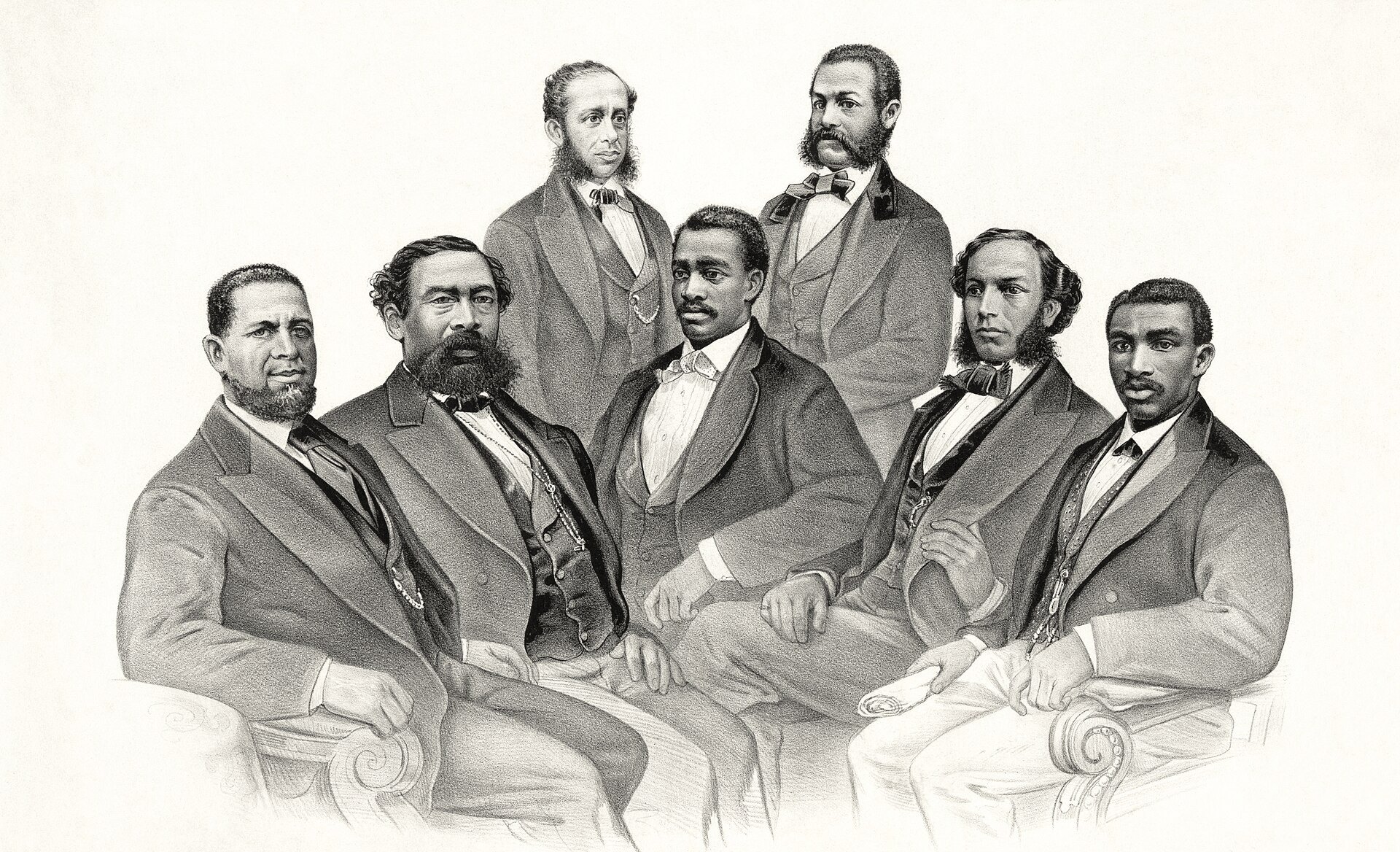
Mississippi did not spend generations waiting for another Black person capable of serving in the Senate. Black Mississippians had demonstrated that capacity during Reconstruction. Their political power was attacked, their voting rights were systematically restricted, and those who challenged their exclusion risked their livelihoods and lives.
The gap Colom has broken was made by people exercising power. Understanding his achievement requires remembering what they did—and the people who refused to accept it.
The democracy that was dismantled
In February 1870, Hiram Revels entered the Senate from Mississippi, becoming the first African American senator in United States history. Blanche Kelso Bruce, who had been born into slavery, followed. He served from 1875 to 1881.
Both were elected by the state legislature, as senators were before the constitutional amendment establishing direct elections. Colom’s victory carries an additional distinction: Mississippi voters have now directly elected a Black senator.
That early history matters because it overturns the suggestion that Black representation had to await some gradual development in Black political ability. The ability was already there. What changed was the capacity to exercise it.
After emancipation, Mississippi’s white leadership sought to preserve control through the Black Codes of 1865, laws that restricted Black people’s work, movement and property. Congressional Reconstruction subsequently opened greater opportunities for Black citizenship and political participation. White supremacist resistance attacked those gains. The campaign known as the Mississippi Plan helped Democrats regain state power in 1875 through violence and intimidation.
The party identification is essential. White Democrats were central to the destruction of Reconstruction in Mississippi. Historical responsibility cannot be reassigned to suit today’s political loyalties.
Neither should identifying those Democrats obscure the larger struggle: people who considered government their racial possession used force to keep it.
The violence helped secure power. The law helped preserve it.
Mississippi’s 1890 constitutional convention sought to exclude Black citizens from politics without openly violating federal protections against racial discrimination. Poll taxes and literacy requirements helped accomplish that purpose.
A rule did not have to name race to serve a racial objective. A registrar authorised to judge someone’s interpretation of the constitution could decide whose answer was acceptable. A financial requirement could turn poverty into a barrier to citizenship.
The decisive power rested with the official administering the requirement.
Mississippi continued to refine those barriers. A United States Commission on Civil Rights account describes later provisions prohibiting assistance with registration forms, requiring applicants to interpret constitutional passages chosen by registrars, and allowing rejection when required blanks were not properly completed. Applicants’ names and addresses could be published in local newspapers, exposing people seeking political participation to potential retaliation.
By 1964, only 6.7 percent of eligible Black Mississippians were registered to vote.
It also exposes the dishonesty of treating Black political participation solely as a question of motivation. People were being asked to register under rules designed to reject them, before officials empowered to judge them, in communities where attempting to vote could carry consequences far beyond the courthouse.
The problem was never simply persuading Black citizens that voting mattered. Those working to exclude them understood perfectly well that it did.
Violence, and the people who made participation possible
Emmett Till was 14 when he was abducted and murdered in Mississippi in 1955. An all-white, all-male jury acquitted Roy Bryant and J. W. Milam. The two men later admitted the killing to a journalist.
Till was a child visiting from Chicago, not a voter-registration organiser. His murder belongs in this history because political exclusion operated within a broader system of racial control. The killing and acquittal demonstrated what could happen to a Black person accused of crossing a racial boundary—and how little protection the justice system might provide.
For those directly challenging political exclusion, the danger was equally clear.
Medgar Evers organised voter-registration drives and pressed for school integration as the Mississippi field secretary of the NAACP, the civil rights organisation. On June 12, 1963, he was shot outside his Jackson home. His killer, Byron De La Beckwith, was not convicted until 1994.
The decades between murder and conviction are part of the injustice.
In June 1964, James Chaney, Andrew Goodman and Michael Schwerner were murdered while engaged in civil-rights work, including efforts to register Black voters. The federal investigation documented a conspiracy involving members of the Ku Klux Klan and local law enforcement.
That involvement matters. The danger came partly from people entrusted with enforcing the law.
Black Mississippians were never merely the subjects of this violence. They organised against it.
Fannie Lou Hamer’s sworn testimony describes her arrest and brutal beating in Winona in June 1963 while returning from a voter-registration workshop. Other civil-rights workers were also attacked. People learning how to exercise and teach citizenship were punished in custody.
Hamer continued.
In 1964, she and the Mississippi Freedom Democratic Party challenged Mississippi’s regular delegation at the Democratic National Convention. Their argument confronted the legitimacy of a political organisation that excluded Black citizens while claiming to represent the state.
National party leaders offered the Freedom Democrats two seats. They rejected the compromise.
The episode prevents an easy division between a backward state and an enlightened national establishment. Those demanding equality also confronted leaders who wanted to contain their demands.
Colom’s victory draws meaning from that struggle. Contemporary voters made their own choices about a contemporary candidate. But their ability to choose rests on work performed by people who faced eviction, assault and death for demanding a place in public life.
Their achievement was larger than helping any future politician win. They established that Black citizens were entitled to decide who governed them.
Rights required enforcement
The Voting Rights Act of 1965 recognised the failure of constitutional promises without effective protection. It established enforcement mechanisms including federal examiners and advance federal review of voting changes in covered jurisdictions.
The premise was rooted in experience: institutions with records of exclusion could not simply be trusted to correct themselves.
In 2013, the Supreme Court’s Shelby County v. Holder decision invalidated the formula determining which jurisdictions were subject to that advance-review requirement. Jurisdictions previously covered by the formula consequently no longer needed such approval, although separate court orders could still require it.
Colom’s election cannot settle the argument over those protections. A Black candidate can win while individual voters encounter unjustified barriers.
Mississippi’s own history warns against treating a breakthrough as a permanent guarantee. Reconstruction produced Black senators. The political system that followed eliminated the conditions that had made their service possible.
One senator’s slip, and the seat she lost
In October 2022, President Biden nominated him, then a district attorney in northeast Mississippi, to the federal district court for the northern half of the state. Senator Roger Wicker, a Republican, backed the nomination by returning his blue slip. Senator Cindy Hyde-Smith, also a Republican, did not. On 4 April 2023 she said she could not support Colom for a lifetime judgeship, citing his opposition to legislation protecting female athletes, his support for transgender rights, and 2015 support from a political action committee funded by George Soros. She also said she found him smart and well liked, the Mississippi Free Press reported.
The blue slip is not in the Constitution. It is a Senate Judiciary Committee custom that lets a nominee’s home-state senators stall district-court and US-attorney nominees by withholding the slip, and the committee’s chair decides whether to honour it (The Week). Her refusal ended the nomination before any hearing or vote.
Using that custom was lawful, and she gave her reasons, which not every senator does. Still, it raises the question this article keeps asking of Mississippi’s history: who holds the decisive power, and who can check it?
Colom says he did not run to settle a score. He told Semafor in March that it was “easy for me to forgive” a senator for stopping a nomination, and that he was running over her record (Semafor). Her campaign did not address whether the nomination fight shaped his decision and questioned his position on transgender issues instead. Whatever drew him in, if he is sworn in as one of Mississippi’s two senators, the custom would give his slip the same weight hers had, for as long as the committee keeps it. Whether he uses it, and how he explains it, is a fair test of the question above.
Registration and the ballots a victory cannot explain
Mississippi does not offer online voter registration. Residents register by mail or through clerks, driver’s-licence services and certain agencies, generally at least 30 days before an election. That absence does not, by itself, establish an intention to suppress Black voters; that allegation requires evidence. But a paper process makes registration depend on getting a form, completing it correctly, delivering it and having it processed, which can be a real barrier for someone with limited transport, unpredictable working hours or unstable housing. What benefit justifies it? How often do applications fail to reach the rolls? Who is told of a problem, and how long do they have to fix it? Mississippi’s history makes those questions necessary.
The counting in Hinds County supplies an immediate reason for scrutiny.
On November 11, the Mississippi Free Press reported that county officials accepted 817 affidavit ballots and rejected 1,609. An affidavit ballot is one cast provisionally when a voter’s registration or eligibility is in question. In the district that includes Jackson State University, officials accepted 181 and rejected 482. The county’s election commissioner attributed the Jackson State rejections to paperwork from a campus registration drive that missed the circuit clerk’s deadline, the Free Press reported. Colom leads by more than 3,000 votes, so the rejected ballots in Hinds County could not by themselves have changed the result.
Those figures do not establish that the rejected voters were eligible, that they were all Black or that officials discriminated against them. They do require a clear public explanation.
How many rejections concerned registration applications that had not reached the rolls? What opportunity did people have to correct an error? If a voter believed a registration drive had registered them, where did the process fail?
An eligible voter excluded through an avoidable administrative failure has suffered a loss even when the preferred candidate wins. The right belongs to that person. Its importance does not depend on whether one more ballot would change the outcome.
The university’s responsibility, and what Mississippi owes
The University of Mississippi carries its own history of resistance to Black inclusion. When James Meredith enrolled in 1962, a segregationist riot surrounding his admission left two people dead.
The apartment video must be examined on its own facts. The university says it is investigating. One woman identified in the footage apologised and said she had not known the occupants’ race; the residents told CBS that the other woman kept making the gestures during the apology. The university’s Black Student Union called for an investigation, support for the affected students and stronger education about the university’s values.
A racist gesture in 2026 is not equivalent to a deadly riot in 1962. The connection is the continuing struggle over who can expect respect and security there. Animalising gestures invoke a tradition of denying Black people equal humanity, and outside students’ own home, belonging becomes an immediate question. What protection and support will they receive? What can the university say publicly about its response while respecting their privacy? Mississippi’s election result cannot answer for them.
Colom’s victory deserves celebration. It also creates responsibilities.
He will be accountable for how he uses the office, whose rights he defends and whether he challenges institutions that fail his constituents. Historical significance gives his election weight. His conduct in office must give that weight substance.
The state’s long absence of Black Senate representation was produced by identifiable acts: violence, discriminatory laws, official discretion and failures of protection. Describing that history as a slow march towards progress hides the decisions that delayed it.
It also understates the achievement of those who resisted. Black Mississippians did not receive political power because time passed. They organised, challenged officials, endured retaliation and forced institutions to recognise rights they had denied.
Colom will enter a chamber that Mississippi had already sent Black men to in the nineteenth century. Between their service and his election lies a record of democracy dismantled and citizenship fought for again.
Mississippi has elected a Black senator. The measure of its democracy remains whether every Black citizen can exercise a right, enter a public institution and expect protection without first having to fight for recognition as an equal.

Comments
Every comment is read by a person before it appears, so yours will not show straight away. We publish comments that are civil and on the subject. To report a mistake in the piece, use the corrections page, so it is fixed in the piece itself.