Editor’s Note: Faisal Omar, a freelance photojournalist and reporter in Mogadishu, wrote this account of Merca, where he was a Radio Shabelle cameraman from 2007 to 2013. He did not see the killings he describes: each reached him by phone or from colleagues, and he says so. The account of the July 2015 wedding killings is Human Rights Watch’s and the Voice of America’s. I edited it for The Field, left out technical detail on how bombs were placed, and checked the outside sources. On 12 November I asked Uganda’s army (UPDF) and the African Union mission (AUSSOM) to respond. The email to the AUSSOM press office was returned undelivered, so that request has not reached it, and UPDF had not replied by 14 November. Any reply will be added here.
Our old house stands by the first bridge into Xaafad Ruusiyo, the neighbourhood in Merca, in Somalia’s Lower Shabelle region, where I grew up. I last saw it in 2016, when it was already in ruins, its front wall pocked with large bullet holes that I believe came from the heavy machine guns of African Union peacekeepers. Nobody lives there to this day. The convoys have stopped, but my parents and I have not rebuilt it, because we are not sure Merca will stay stable.
I want to explain how that wall came to look like that, and why I think the families of Xaafad Ruusiyo were made to pay for a military plan they had no say in. Please read the rest as my account. I worked as a cameraman for Radio Shabelle in Merca from 2007 to 2013, and my family’s house stood one block from that bridge. I did not see the three killings I describe below myself. People who were there phoned me, and I say who below. My argument is simple: when one side’s supply route is predictable, the other side’s bombs are predictable too, and both land on the people who live along the road.
A road everyone could see
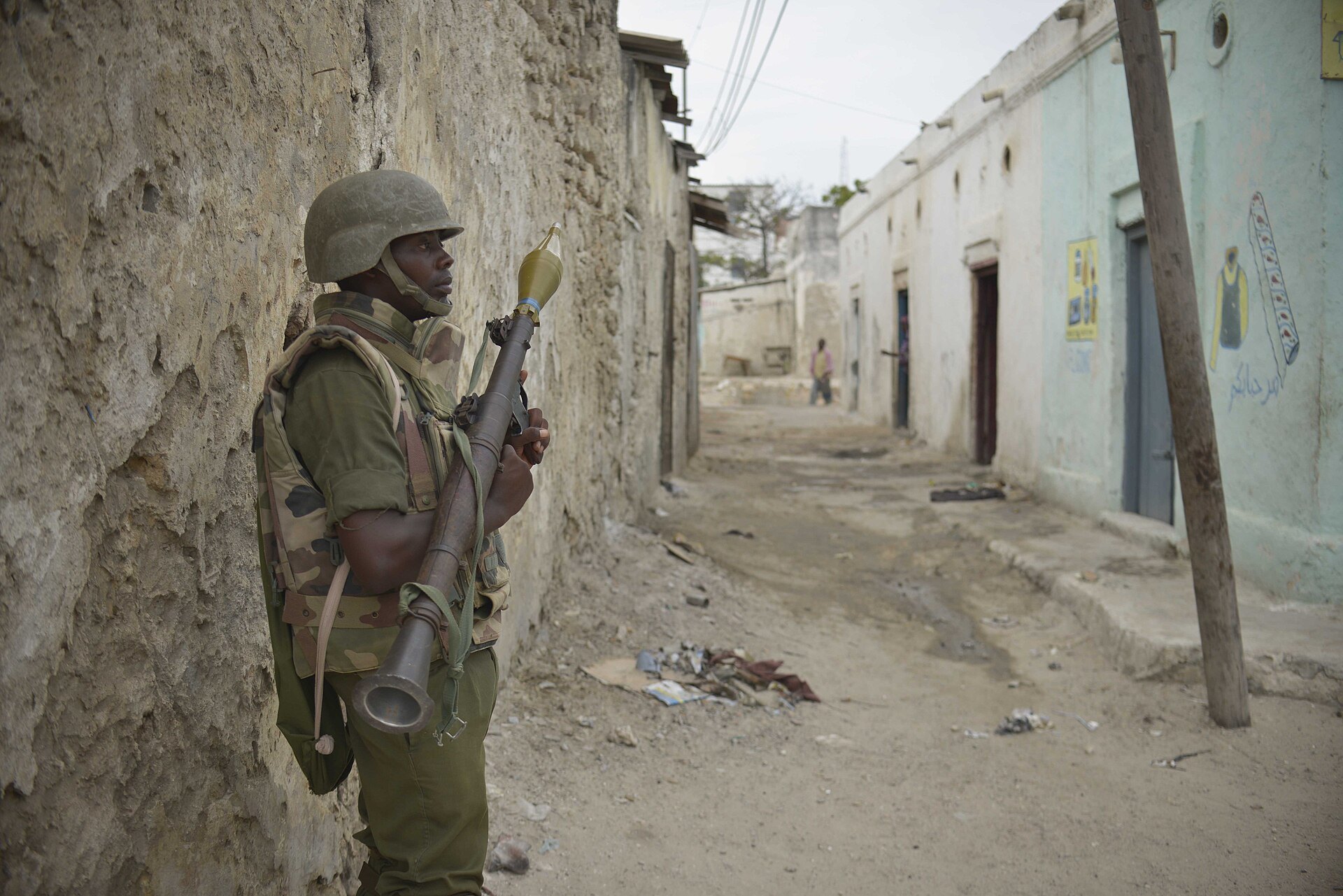
African Union troops, known then as AMISOM, and Somali government forces took Merca from Al-Shabaab at dawn on 27 August 2012. Outside Somalia it was treated as a step toward stability. In Xaafad Ruusiyo it changed what the main street was. AMISOM put a base on the far side of the neighbourhood, near Obasiibka, away from its main base at the city entrance. As I knew it, supply convoys had to cross the whole town twice a week to reach it, and there was one road to take, over two bridges. The first bridge sits at the entrance to Xaafad Ruusiyo, and the second is further out on its edge. Anyone watching could tell when a convoy would come.
AMISOM has said its convoys in Merca were repeatedly attacked by Al-Shabaab, according to Human Rights Watch, and that its troops answered in self-defence. I do not dispute that the convoys were attacked. What I can tell you is what that meant on our street. After a bomb went off, residents told me, the soldiers fired heavily into the houses along both sides of the road, and in some cases went inside to search them.
Families also learned to leave. The convoy schedules were widely known across the neighbourhood, and on convoy days Al-Shabaab passed an order through the local elders telling everyone in the area to abandon their homes, so that every household cleared out together. My family was among those living nearest the main road, and we went deeper into the neighbourhood. Day labourers and passers-by got no such warning, and I am told the attacks went ahead whether or not outsiders were on the road. The meetings between the elders and Al-Shabaab leaders were widely known across the city. Whenever civilians were killed in an attack, the elders went to the commanders to ask them to change how they operated in civilian areas. I was told the group agreed to stop attacking convoys in active market areas but refused to stop in Xaafad Ruusiyo, saying the residents should abandon their homes instead. As residents described it to me, the peacekeepers’ return fire often hit those empty houses, which left them unlivable and pushed families out for good. Mine was one of them.
The killings I was told about
In 2014, the owner of a new English school phoned me from the scene right after a man was killed outside it. As he described it to me, the dead man was a well-known deaf signwriter who had been up a ladder fixing the school’s signboard to the wall, unable to hear the warnings shouted along the street. The owner told me he was hit by return fire from AMISOM after a grenade attack on a passing convoy.
Later that year, Merca General Hospital phoned me to say that a man, shot while walking home from a mosque, had been killed by AMISOM forces, and to ask whether Radio Shabelle wanted to interview his relatives. The station interviewed the family. They received no compensation, and nobody was held to account for the shooting. I was not at the hospital.
In 2015 there was an incident on the outskirts of Merca, between Ceeljaale and the town. My colleagues at the radio station talked about it at the time. There were deaths and injuries, but I do not know how many, and I did not see it. I have found no public report of it, so I give it only as what my colleagues told me.
What the record says, and what it does not
Some of what happened in Xaafad Ruusiyo is documented by others, and I want readers to know where my account ends and theirs begins. After a bomb attack on an AMISOM convoy on 31 July 2015, Human Rights Watch reported, Ugandan troops went into houses in Rusiya, as the neighbourhood is also spelled. At a wedding in the Moalim Iidey family’s house, it said, they separated the men from the women and shot six men: a father, four of his sons and an uncle. One son died later after hiding under a bed, and the father died overnight after, the family said, soldiers would not let them take him to hospital. The soldiers were from the Ugandan army, which Human Rights Watch said made up the AMISOM force based in Merca.
The mission’s own public statements went part of the way. On 21 August 2015, at a press conference in Nairobi, its head, Maman Sidikou, said AU forces had killed seven civilians and that three Ugandan soldiers had been indicted for violating rules of engagement, according to the Voice of America. Days earlier, Human Rights Watch had reported that six witnesses said AMISOM had killed at least 11 civilians on 21 July in Rusiya and two nearby neighbourhoods, which AMISOM first denied. I have not found a public report of what became of the three soldiers. Merca’s mayor said he had heard of six civilians killed in the 21 July raid, not the 11 that Human Rights Watch reported, according to Garowe Online.
A later case in the same region is also on the record. In December 2016 AMISOM said its troops had shot dead six passengers in a minibus that was told to stop at a roadblock in Qoryooley, another Lower Shabelle town, and blamed the driver for reversing instead of stopping, Radio Dalsan reported. Friends in Merca reminded me of it this week, and I did not see it. The 2015 wedding killings are the one event in my account that outsiders have investigated in Merca itself, and I cannot say how typical it was. I do not know how many civilians died inside the five-to-seven-block stretch on the road, because hospital records in those years often mixed bomb injuries with fighting. I do not have AMISOM’s internal inquiry files, so I cannot say who ordered the house-to-house searches.
Today AMISOM no longer exists under that name. It became ATMIS and then AUSSOM, the African Union Support and Stabilization Mission in Somalia. I am told the Somali army now holds the main checkpoints in Merca, but Al-Shabaab still attacks supply routes in Lower Shabelle with roadside bombs. I do not know whether AUSSOM keeps watch near the old bridge.
What I do know is the wall. A convoy route is a military plan, and the people living beside it were never asked about it. They were used as cover by one side and became a target for the other, and the heaviest cost was paid by people who owned neither a weapon nor a say. Our house by the first bridge is what that cost looks like.
Comments
Every comment is read by a person before it appears, so yours will not show straight away. We publish comments that are civil and on the subject. To report a mistake in the piece, use the corrections page, so it is fixed in the piece itself.