
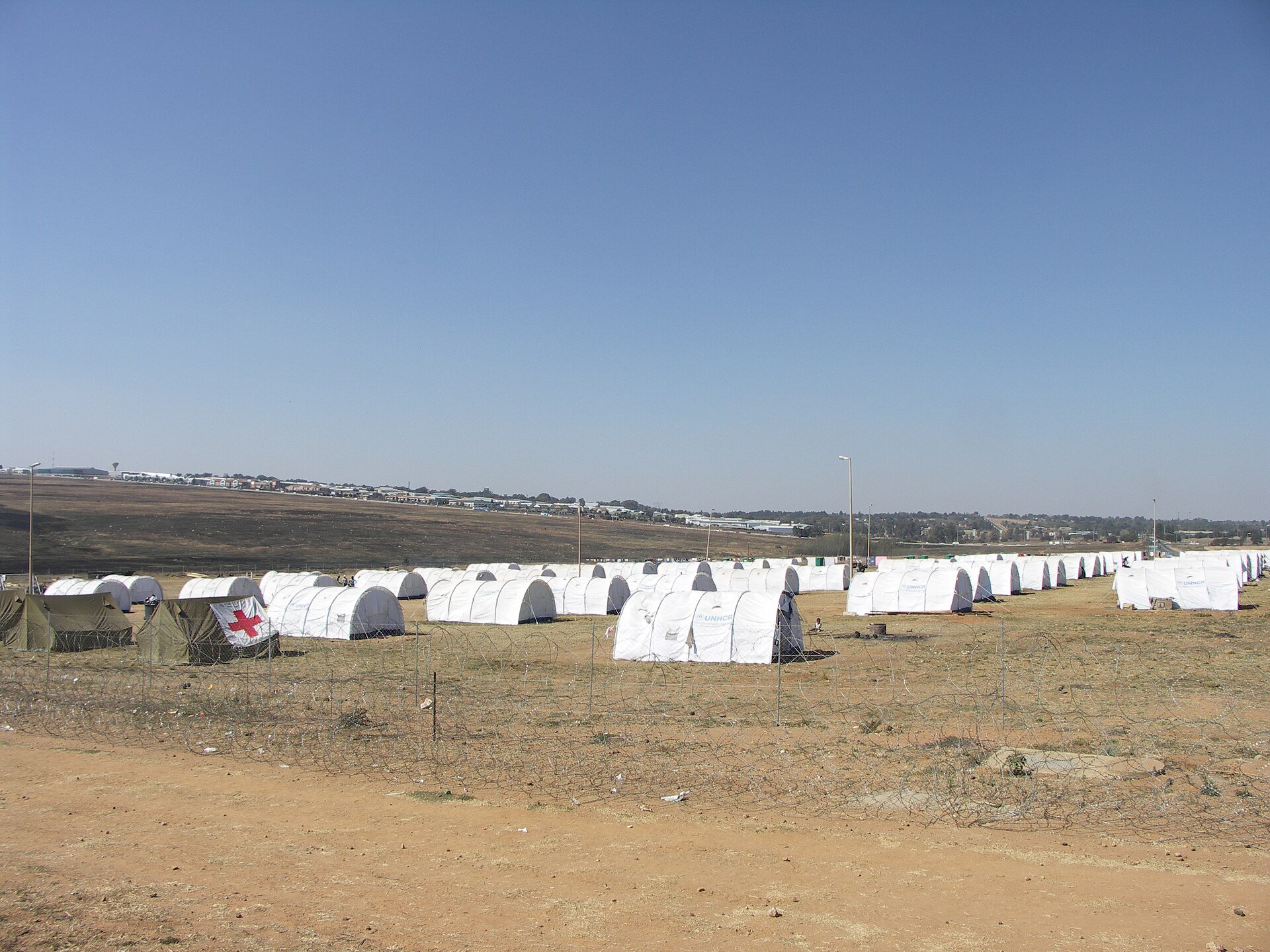
In December 1994, eight months after South Africa’s first democratic election, groups of armed men in Alexandra, a township in Johannesburg, began pushing people out of their homes. Human Rights Watch reported that over several weeks the groups tried to evict people they called “illegals”, mostly Mozambicans, Malawians and Zimbabweans, in a campaign called Buyelekhaya, “go back home”. The men marched their targets to the local police station and demanded they be sent home. Most of the undocumented migrants were repatriated.
That is the earliest case I could document. Some of the attackers said they belonged to the ANC, the Communist Party and the civic organisation SANCO. All three denied it, and some condemned the attacks.
This piece starts there because the violence is often described as something that began in 2008, or 2015, or this year. It did not. I was living in South Africa in 2008, and I stayed until 2014. I saw part of what follows. The rest comes from reports, court records and official figures, and I say which is which.
By the 2000s the targets included Somali shopkeepers. The Mail & Guardian reported in October 2006 that media reports put the number of Somalis killed that year at more than 30. The counts differ, and I found no official one.
May 2008
The national wave began in Alexandra on 11 May 2008. The Wits report counts at least 62 dead, including 21 South Africans, at least 670 wounded, dozens of women raped, and more than 100,000 people displaced. Other counts differ. The UN refugee agency’s Global Report 2008 gives an official figure of 46,000 foreigners displaced between May and August and says other estimates were much higher. I could not find how the official number was counted.
The most widely seen image was of Ernesto Nhamuave, a 35-year-old Mozambican, beaten, stabbed and set alight at Ramaphosa informal settlement on 18 May. Police closed the case on 27 October 2010 with no suspects, the Sunday Times reported in 2015.
The justice department told Parliament in 2015 that 597 cases from the violence had gone to court by the end of October 2009. Of those, 218 were withdrawn. 159 ended in a verdict: 98 guilty and 61 not guilty. The rest were unfinished, awaiting investigation or still to be tried. The department’s own figures add up to 538, not 597, and the reply does not explain the gap.
What I saw
In 2008 I was living in Mpumalanga province.
The province’s main city became a place where foreign shop owners ran to be safe. They came from the townships and locations around the province, and in the evening they came into the city. They slept mostly at the houses of relatives and friends, and some slept in foreign-owned hotels. In the morning they went back to their shops, until the situation settled. In the city itself nothing major happened. The shop owners were Somalis, Indians, Bangladeshis, Pakistanis, Ethiopians, Tanzanians, and many Malawians.
In townships such as Matsulu and Pienaar, ordinary citizens came to foreign shop owners and warned them that when the protests started, people would come and loot their shops. Then the police told the shop owners to close their shops to avoid being attacked. They all followed the police orders. The police also told the townships to avoid people gathering to protest. While the shops stayed closed, police patrolled, to prevent people gathering for protests. No one described the police protecting the shops themselves. Pienaar was one of the hot zones in Mpumalanga, and a lot of shops were looted there. I do not know whether that was in 2008 or in one of the later waves. There were so many.
From 2008 until I left in 2014 I went to Johannesburg twice a month to buy stock for a shop. Every time I left Mpumalanga and entered Gauteng, the first townships and locations I passed had been affected. I saw burned cars, burned public transport, burned shops and burned tyres, some of them in the middle of the road. I saw people dressed for protest, still protesting in the daytime, and police firing rubber bullets to disperse them. In Johannesburg I went to my hotel and watched the news, and the news matched what I had passed.
I saw some things only on video: shops being looted, and people burned alive with tyres. Other things I only heard or feared: people carrying machetes, and foreigners on public transport between townships being pulled off and killed. I give those as what I saw on screen or heard, not what I saw in person.
I did see looters fail. Some shops were broken into but the looters could not get inside, and then the police arrived and the looters ran.
Shop owners told me directly what had happened to them, over the years I was there. I met some of them in Johannesburg. One said his shop was burned while he was inside, and he escaped through the back door. Others said their shops were looted and they had to leave. Others said they tried to defend their property and were injured.
People in the community also passed on stories of deaths. Someone would say that another person’s cousin, or uncle, had died in his shop because he tried to run and could not get out, and that some died protecting their property. I did not know these men. I cannot confirm these stories, and I give them only as what was said.
After each wave, the shop owners I knew reopened. They did it with donations from other people from their own country, or with loans. I helped some of the shop owners I knew reopen, restocking the shelves. The shop owners I knew received no compensation from the police, the government or any relief agency. I found no public record of a compensation scheme for foreign shop owners. Whether one exists is a question for the government. I asked the Presidency and the Department of Home Affairs, and neither had responded when this was published.
When shops were looted or vandalised, the police came and wrote a report. That was the last the shop owner heard of it. I saw this happen, and people from the Pakistani, Indian and Malawian communities told me the police never did anything. In my experience this is why foreign communities do not trust the police much. In my view the police are overwhelmed and outnumbered.
Until I left in 2014, I saw it get worse every year. It spread from areas that were already hot to areas that had been calm the year before. Since 2014 I have followed it in the news.
2015, 2019 and 2026
I was not in South Africa for the next two big waves, so the facts here come from reports.
In April 2015 violence began in KwaZulu-Natal. The UN refugee agency counted six dead over three weeks and more than 5,000 displaced in the province. Two men were later sentenced to 17 and 10 years for killing Emmanuel Sithole, a Mozambican stabbed in Alexandra on 18 April. The justice department said that by the end of July 2015 it had 110 cases on the court roll from that wave, and four convictions.
In September 2019, rioting in Johannesburg and Pretoria killed people on both sides. The government said 12 people died, 10 of them South Africans. Human Rights Watch found at least 18 foreigners killed between 2 and 9 September. Arrests reached close to 700, but HRW wrote that virtually no one has been convicted for the attacks of 2019, 2015 or 2008.
I have followed 2026 from outside South Africa, through reports.
On 26 and 27 April, four Ethiopian men were shot dead in central Johannesburg. The government says it treats those killings as organised crime and has found no credible link to the protests.
March and March and Operation Dudula were reported to have set a 30 June deadline for undocumented foreigners to leave. March and March denies issuing a deadline and says its protests are peaceful. On 30 June police said more than 900 people were arrested and that 108 of 120 marches were peaceful. Shops were looted in Durban and Johannesburg.
How many people died is disputed. South African police and the UN committee that monitors racial discrimination say at least four migrants were killed, and the committee says at least 50,000 people were forced from their homes. Nigeria and Ghana say more of their citizens were killed, and South Africa disputes those claims. Mozambique said five of its citizens died in Mossel Bay at the end of May, but Reuters reported on 2 June that police had confirmed only two, and had made no arrests. For comparison, 62 people died in 2008. The violence has not stopped. On 22 October, Al Jazeera reported that a mob of about 50 people beat a foreign national to death in central Durban. Police said investigators were still trying to identify suspects. The 2026 wave also stands out for departures: the justice minister said 86,596 foreign nationals were processed for deportation or repatriation between 14 June and 20 August.
What the record shows
Xenowatch, the University of the Witwatersrand project that tracks these incidents, counts 1,371 incidents from 1994 to 30 September 2026, with 706 deaths and 5,707 shops looted. It says its counts are lower than the real figures, so I treat them as a floor. The record I could find shows few convictions and an unfinished set of promises.
For 2008, 98 guilty verdicts came out of 597 cases. For 2015, four convictions out of 110 cases by July. For 2019, Human Rights Watch found virtually none. Xenowatch counted one conviction among 255 incidents between 2022 and 2024: an Operation Dudula organiser, fined R10,000 or three years, half suspended, for inciting violence with a voice message.
The government adopted a National Action Plan against xenophobia in 2019. HRW wrote in 2020 that it seemed to have had very little impact. The president signed a Hate Crimes and Hate Speech Act in May 2024, but in May 2026 two legal organisations wrote that it was still inoperative because its regulations were pending.
In November 2025 the Johannesburg High Court found that Operation Dudula’s conduct was unlawful, barred it from demanding identity documents, and ordered the state to take reasonable steps to carry out the National Action Plan, including an early warning and rapid response system. I have not found whether the state has done so.
I found no statement in which a politician or party called for people to be killed. What I found is blame. HRW reported that in 2023 the Patriotic Alliance’s leader, Gayton McKenzie, said foreign nationals “must go home”, and warned that such rhetoric risks stoking violence without blaming specific attacks on it.
What I do not know
I could not find whether any compensation has ever been paid to foreign shop owners whose shops were looted, or what happened in Pienaar and Matsulu, because no published report I found mentions them. The official toll for 2026 is at least four, and other governments say more. I also do not know whether the state has carried out the High Court’s order, when the hate crimes regulations will be final, or why the justice department’s 2008 case figures do not add up.
What should change
In my view, many people in these foreign communities went to South Africa because they were running from life-threatening danger at home. What they found instead was an unsafe place. South Africa joined the African Union’s refugee convention in 1995 and the UN Refugee Convention in January 1996, according to Human Rights Watch. Its Refugees Act bars sending refugees back to danger. In July 2026 the Constitutional Court struck down rules that blocked asylum claims.
Not everyone who is attacked is a refugee. Many are migrants. But those who are refugees cannot go back without facing danger, and they need to be protected under international law and international human rights law. In my view the South African government has not kept that promise and should do more. It should come back to every shop owner whose report the police wrote and never followed up. It should bring regulations into force for the hate crimes law, enforce the court’s order, and say publicly how many people have been convicted for each wave. And it should tell foreign shop owners what happened to the reports they filed.
The Presidency, the South African Police Service, the Government Communication and Information System and the Department of Home Affairs were asked for comment on 17 October and had not responded when this was published.
Comments
Every comment is read by a person before it appears, so yours will not show straight away. We publish comments that are civil and on the subject. To report a mistake in the piece, use the corrections page, so it is fixed in the piece itself.