Editor’s Note: Nhlanhla Nkosi describes himself as a gender-based violence specialist at the African Development Bank in Pretoria. The views in this series are his own. I checked the main figures in this piece against the reports linked in the text.
Ismail Abukar
In Cape Town’s Slave Lodge, the door opened every night between eight and nine o’clock. Free men came in and spent the hour with enslaved women. The Dutch East India Company, which owned the Lodge, had forbidden relationships between enslaved women and European men since 1671, but Iziko Museums says the Company never acted to stop the visits. The women left no account of their own. What is known comes from men who wrote about the Lodge, and some of them wrote that the women were pushed into it by the men they lived with. That rule is more than three times older than the Walt Disney Company, which was founded in 1923.
More than 350 years later, almost half of South Africa’s reported rapes still happen behind a closed door. On May 22, Police Minister Firoz Cachalia released the police’s crime figures for January to March 2026. Of 9,782 rapes reported, 4,620 happened at the home of the victim or of the attacker. That is 47.2 percent. SAnews reported that he described them as rapes “committed not in dark alleys by strangers, but in homes, by people known to the victim.” In the same quarter, 1,523 murders also happened at the home of the victim or of the attacker. About 108 rapes were reported every day across those three months. The next quarter, April to June, had 9,201, or about 100 a day, The National reported.
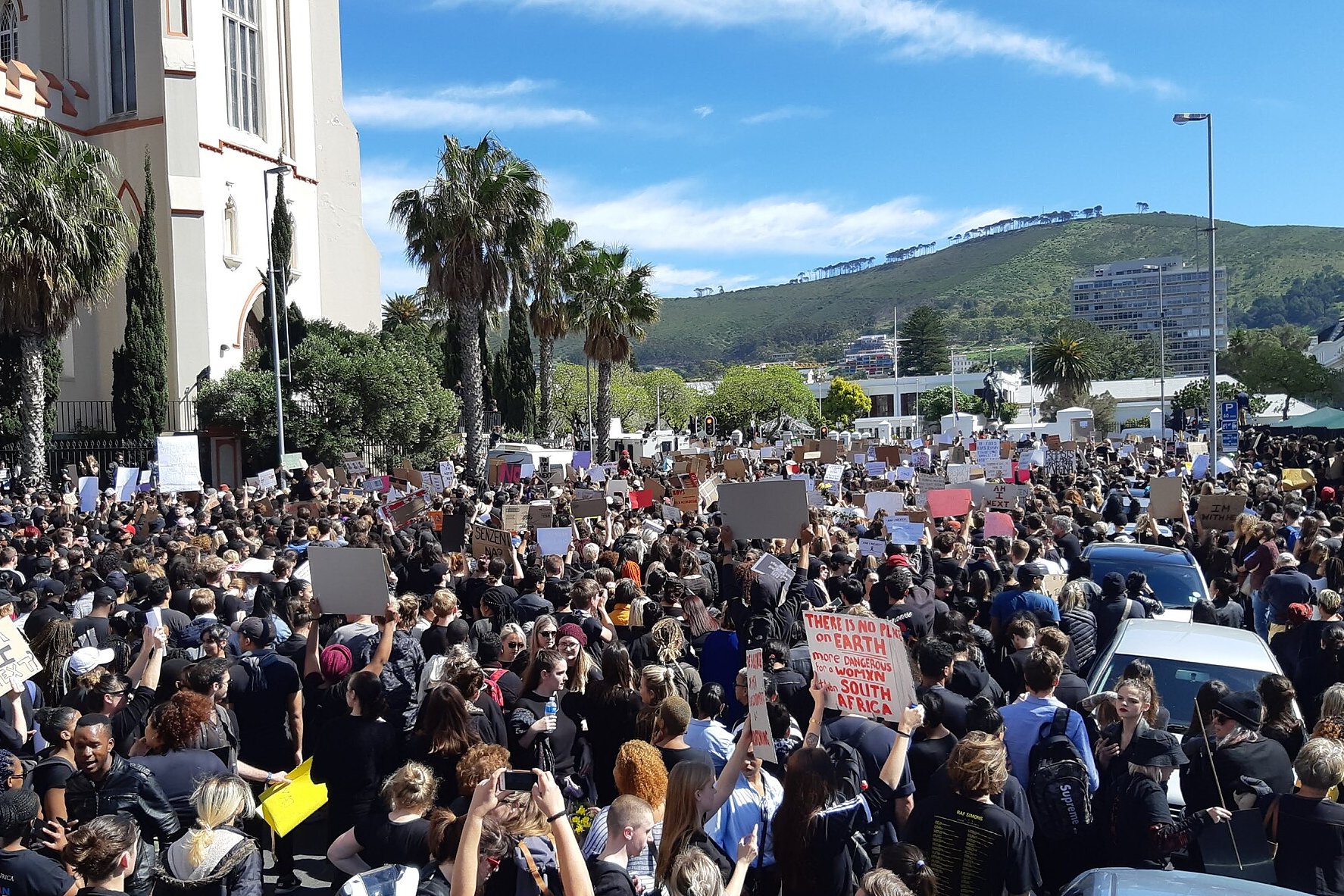
Four months later, on September 29, President Cyril Ramaphosa answered the discovery of 11 women’s bodies in Ekurhuleni, the city east of Johannesburg, with four emergency steps. Police and prosecutors were given 60 days to audit unresolved cases. Police were given 60 days to produce a funded plan to clear the backlog of forensic evidence, such as DNA samples, that has not been processed. Every municipality was told to list its unsafe places, such as broken streetlights and unsafe transport routes, within 60 days. A package of laws against alcohol-related violence was to go to Cabinet in the same time. Sixty days from the speech is about November 28, three days after the annual 16 Days of Activism against gender-based violence begin on November 25.
This piece asks one question of those four steps: do they reach the place where nearly half of reported rapes happen? My answer is that they mostly do not, and that this is an old habit and not a new mistake.
What the state knows
The habit is easy to describe. A rule is written, and the place where the harm happens stays unwatched. The rule of 1671 did not stop the visits. In November 2018 a presidential summit on gender-based violence ended with a declaration. In November 2025, after a Women for Change petition gathered more than a million signatures, the government classified the violence as a national disaster, and this year it set deadlines. In each case the promise was public and the harm stayed behind a closed door.
Many killings of women also come from someone close to the victim. In its fourth national femicide study, the South African Medical Research Council found that 60.1 percent of women murdered in 2020/21 were killed by an intimate partner, such as a husband or boyfriend. Femicide means the killing of women. The study also found that fewer than one in five of those intimate-partner cases ended in a conviction.
Soul City Institute for Social Justice read the same police figures in May and said the crisis is “rooted in everyday relational and domestic spaces.” It said South Africa remains “highly focused on reactive systems”, meaning policing, reporting and the response after violence, while underinvesting in prevention within families, schools and communities.
A fair reader will ask whether the 47.2 percent is real or only what police happened to record. The 4,620 is a floor, and nobody can say how far below the truth it sits. The figure counts rapes reported to police, and the fact-checking group Africa Check found no current national estimate of how many are never reported. The last national estimate, from 2002, was that about one in nine rapes reached the police. A study in Gauteng in 2010 put it at 3.9 percent, and Rape Crisis, a Cape Town advocacy group, estimated in 2018 that only one in 13 sexual offences, or 7.7 percent, reached the police. All three are estimates and not counts, and none is a current national figure. We therefore do not know whether the unreported rapes happen more often at home than the reported ones. We only know that the one official source says almost half of the reported ones do.
The state has also made the question harder to answer. Amnesty International South Africa said in August that in August 2025 the police stopped publishing some detailed crime figures, including those on the murder and assault of women and children, citing accuracy concerns. Amnesty called reliable data “a prerequisite for accountability”. Numbers the public cannot see cannot be used to hold anyone to account.
What the plan counts
The four steps are not wrong. Many of the Ekurhuleni women were found in open veld and beside roads, and only two of the 11 had been reported missing. Streetlight audits belong in that response: a Daily Maverick journalist who walked an Ekurhuleni neighbourhood at night in October wrote that most of the streetlights were out. So does alcohol: the minister said 7,267 murders, attempted murders, rapes and serious assaults in that quarter were linked to drinking. The case audit and the forensic plan help every case that reaches the police, including the ones from homes.
But two of the four steps are about public space and drink, and the other two begin only after a case exists. What a woman in a home needs happens earlier. Someone has to answer her call. A police officer has to open the case. A protection order, which is a court order telling a violent partner to stay away, has to be served on him. Parliament’s police committee, the group of MPs that oversees the police, found 59 cases between October 2023 and March 2024 in which stations broke the Domestic Violence Act: they did not help complainants open cases, or did not serve protection orders. The committee said poor service lowers victims’ trust and their willingness to report. Phinah Kodisang, the chief executive of Soul City, said there is “generally a distrust of the police”. The first piece in this series reported that the police watchdog registered 116 rape cases against police officers in 2025/26. That is small against the more than 9,000 rapes reported to police each quarter, but it feeds the distrust Kodisang describes. And when a woman does leave, the places that take her in are short of money: the National Shelter Movement said in September that about 90 percent of the roughly 100 shelters it supports struggle with funding and other support.
Progress so far is counted mostly in the four steps. Gauteng, the province where the Ekurhuleni women were found, gave the fullest update on November 1. It said that 21 of its 67 directives, the tasks it set itself under the President’s plan, were complete, 38 were under way and 8 had not started. The numbers it gave are for the four steps: 7,322 liquor outlets inspected and 20 closed, forensic kits recovered from care centres, and municipal safety audits between 60 and 80 percent complete in most municipalities. The province also added a fifth priority of its own, support for survivors, and reported 18 shelters with 363 beds and new referral tools in all 43 of its protection-order courts. That is the closest any of it comes to the home. The update gives no figure for calls answered from a home or for protection orders served. That is not proof that nobody is counting them. It does show what the state has chosen to count first.
The deadline that matters
From my work on gender-based violence policy in Pretoria, I read South Africa’s declarations as a cosmetic substitute for political courage. A declaration costs nothing. The Nelson Mandela Foundation said on September 21 that a national disaster classification “must mean something in practice”, and its chief executive, Mbongiseni Buthelezi, said women have to be able to feel that something is changing “in their homes, communities, police stations, courts, workplaces and places of learning.” A count of protection orders served takes a police station effort, and it may show something unflattering. The test of the plan is therefore not whether the November deadline is met, but what the audit counts when it is.
Three things will show it. The first is whether the case audit records where each case happened, so that the home appears in the numbers. The second is whether the police restore the crime figures they stopped publishing in August 2025, so that the next quarter can be compared with the last. The third is whether any station, province or minister reports how many protection orders were served and how many cases were opened after a call from a home. If those figures appear, the home has entered the plan. If they do not, the plan will have lit the road and left the room dark, and the old habit will have held: a rule on paper and a door left as it was.
None of this explains why the home is where it happens. That is the harder question, and it is the subject of the third piece in this series: how violence against women is learned, and tolerated, from childhood.
What to watch. Whether the audits due about 28 November count where cases happened, whether SAPS restores the crime data it stopped publishing in August 2025, and whether police report how many protection orders they serve.
Comments
Every comment is read by a person before it appears, so yours will not show straight away. We publish comments that are civil and on the subject. To report a mistake in the piece, use the corrections page, so it is fixed in the piece itself.