Editor’s Note: Amina Hussiein wrote this analysis and approved the final text and headline. I checked the figures, dates and sources against published reports and added developments reported on 16 and 17 November.
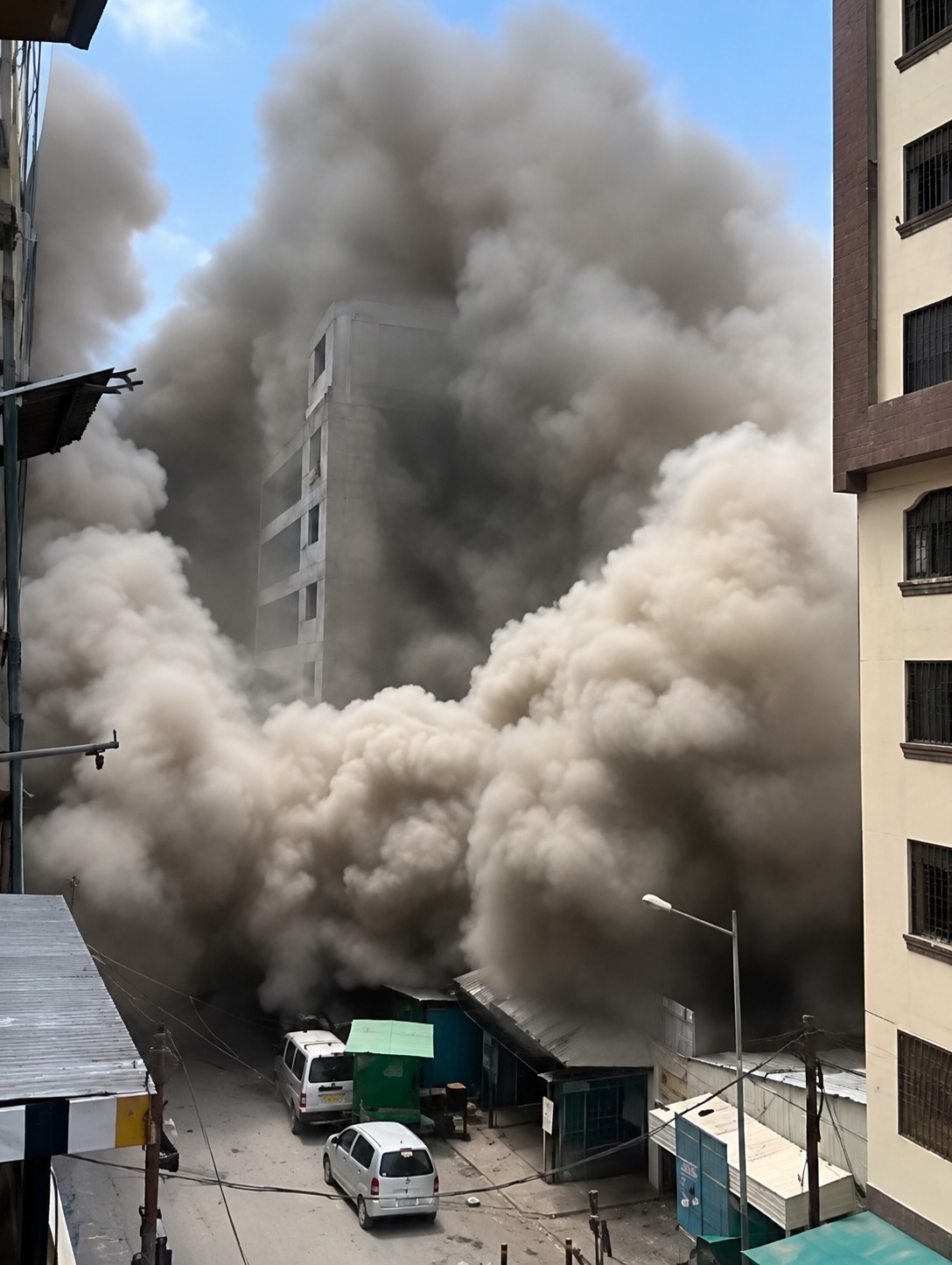
Joseph Kaula, a plasterer, was working on the fifth floor of an unfinished tower in Nairobi’s Eastleigh on Friday 23 October when the building began to fail. He told the Associated Press he was the last person to leave, according to Al Jazeera’s report. Below him, in the basement and on the ground floor, an electronics shop, a butcher and a grocer were open for business. Kenya’s interior minister said 66 of the 67 workers on site got out. The people in the shops did not have the same chance. Relatives said trapped people phoned for help in the first minutes and then could no longer be reached.
The building, reported to be 18 storeys high, stood on 9th Street. The search lasted 15 days. When police called it off on 6 November, eight bodies had been recovered, four people had been pulled out alive and three were still missing. The count of the missing moved a great deal along the way: the interior minister spoke of about 11 people unaccounted for on the first day, and the Associated Press still reported 16 missing as late as 5 November. The families deserve a final account of who was inside, and that remains an open task for the authorities.
Most of the public conversation has asked why the building fell. The engineering answer is not yet known, and it will take an independent examination to establish it. A second question can already be asked, because Nairobi’s own officials have supplied the facts. Tom Achar, the county’s acting compliance director, told county assembly members, in a hearing reported on 6 November, that the Eastleigh building had been flagged and that two enforcement notices had been issued. He also admitted that the department responsible for building approvals and compliance faces political interference, according to The Standard. So the authorities knew. The question is why construction continued after they did.
The warnings were there. What happened next?
Governor Johnson Sakaja has said the county served an enforcement notice in June 2025 ordering the developer to stop work and remove the development. A police record reported by The Standard shows that 14 suspects were booked at Kamukunji Police Station on 17 June 2026 for alleged violations of city planning laws. A separate police record shows 10 of them were released on cash bail of KSh50,000 each. The documents do not show what the charges were, or whether anyone was taken to court, and the paper noted that the fate of the other four is unclear. Sakaja said county officers arrested people again in July after the developer ignored the order.
Release on bail does not prove that the police acted wrongly, and it says nothing about the guilt of the people arrested. But the records give a timeline that matters. The county had acted against the project months before the collapse, and the project went on. Sakaja has asked why the suspects were freed and why construction was allowed to continue, and he argues that counties lost the power to prosecute planning offences in 2024 and need it back.
That argument deserves a hearing, but it leaves a gap. What did the county do after the arrests? Were inspectors sent back to the site, and did they record the building rising? Were further notices issued, or court orders sought? Was the matter passed to investigators and prosecutors? Achar told the assembly that expired notices go to a team of the Directorate of Criminal Investigations, the police detectives, and that a file is with them. Eleven days earlier, on 26 October, the Director of Public Prosecutions had said that no inquiry file on the building had ever reached his office, and ordered the detectives to investigate. Those two statements can both be true if one describes a referral to detectives and the other describes a finished file for prosecutors. Only the records can show which it was.
Kenya’s authorities should publish a clear chronology of every enforcement step, with dates, the offices responsible and the result. Without it, nobody can tell whether the failure lay in weak legal powers, poor coordination, neglected inspections or deliberate obstruction.
Who decides in City Hall?
The county assembly’s inquiry has opened a second line of questions, about how the project got its paperwork at all. On 10 November a private physical planner, Nathan Mutunga, told the assembly’s planning committee that he had processed the application to change the property’s permitted use from a single home to commercial and apartment use. The Daily Nation reported that a county employee allegedly recruited him and paid him KSh121,000 for the use of his professional credentials. He said he never met the developer, and that the documents reached him through a broker, according to a report from Ghetto Radio. The committee chairman warned him about inconsistencies in his account, and a committee member asked whether he had worked with the broker and the county employee to put the application through the city’s online planning system.
A payment does not prove bribery. Planners are allowed to be paid for their work. But a system in which a county employee allegedly finds an outside professional to lodge an application and then handles it inside the same system deserves independent scrutiny. Who commissioned the application? Who controlled the electronic approval? Did the professional make the independent assessment the job requires? The inquiry should obtain the original application, the electronic approval logs, the payment records and the messages between those involved, and it should check whether the same arrangement was used on other buildings. The testimony does not show that this happened systematically. It does give a concrete reason to look.
The testimony about political interference points the same way. Patrick Mbogo, the county’s executive member for urban planning, told the assembly committee that powerful figures in the governor’s office had taken over the approval work of planning officers, The Standard reported, and two advisers were said to be running building approvals. The paper did not name them and presented the claim as reported rather than confirmed. Achar did not publicly name anyone either. At the same hearing, according to The Standard, some directors admitted they were not registered architects or planners, and the assistant director of approvals, Fredrick Ochanda, told the committee he is an architect by profession but not registered. The committee had summoned Ochanda and 25 officers who had failed to come to earlier sessions, and he appeared on Monday 16 November. The developer, the architects and the contractors did not appear, and the chairman said letters had gone out summoning them for the following week, Pulse reported. Advisers to the governor who had been summoned also stayed away, and they are expected to appear.
None of this establishes misconduct by Governor Sakaja or any named official, and the people accused have a right to answer. But the allegation raises a basic question: who in Nairobi actually decides what gets built? Planning offices exist to apply technical rules to approved designs. If technical staff can be overruled by informal instructions, or can issue warnings that nobody enforces, the protection the rules promise to residents becomes unreliable. The assembly should say which officials held legal authority over this project, whether anyone without that authority used it, and whether particular enforcement decisions were improperly influenced. It should publish names, dates and records where the evidence allows, not only general statements about interference.
Approved to change use, never approved to build
The project’s paper trail shows a more specific failure, which is the gap between three different permissions. According to Sakaja, speaking on 24 October, the county approved a change of use for the property on 17 October 2024. Plans for the building, lodged by an architect on 20 November 2024, were never approved by the county, The Standard reported. The governor has also said the building had no certificate allowing anyone to occupy it, so opening shops on the ground floor was illegal. Yet the National Construction Authority had registered the project on 30 July 2025, and the authority lists 9th Street Plaza Limited as the developer and Stromax Holdings E.A. Limited as the contractor. Being named in those records does not establish who is responsible for the collapse.
The new testimony makes the gap wider. Ochanda told the committee on 16 November that the developer had applied to build a residential block of 15 floors with a basement, not the 18 storeys the building was reported to have, and that no application for it was ever approved at City Hall. He also said the letters used to obtain the National Construction Authority’s approval were forged, the Daily Nation reported. That is an allegation by a county official, and no public reply from the authority or the developer had been reported when this was written. It does not tell us who produced any such letters, or whether the authority checked them.
These permissions do different jobs. Permission to change how land is used does not authorise an 18-storey tower. Registration with a national regulator does not show that the county approved the drawings. The useful question is whether any institution checked what the others had decided. What plans did the National Construction Authority hold? Did its records show that approvals were missing? Did Nairobi County tell it about the enforcement notices? And who on the site was responsible, day to day, for confirming that the work was lawful?
The physical cause of the collapse is a separate matter, and approval failures alone do not prove that a design or construction fault brought the building down. But oversight exists to catch dangerous practice before a disaster, which is why the approval trail matters.
A pattern, and how to investigate it fairly
Eastleigh is not an isolated case. Government data cited by the Associated Press records 98 building collapses in Kenya over five years, with 104 deaths and 80 injuries. Al Jazeera, citing AFP, reported that Kenya’s national building inspectorate found that 87 percent of buildings audited last year failed to meet standards or lacked approvals. Buildings fail for many reasons, including design errors, poor materials and workmanship, unauthorised changes and weak supervision, and a missing document is not the same as a defective foundation. But both can show weakness in a system meant to make sure construction is lawful and safe. The wider test is whether inspection capacity has kept up with Nairobi’s growth, with enough qualified inspectors, reliable records and independent technical decisions, and with real consequences for developers who ignore a lawful order.
Corruption has to be investigated, not assumed. A professional has testified about payment from a county employee, officials have acknowledged interference, and the approval history is disputed. Those facts justify examining whether improper influence, conflicts of interest or unlawful payments shaped decisions. They do not yet establish a crime. A credible inquiry follows records, not rumours: it preserves the electronic approval history, collects official correspondence, examines financial transactions where the law allows, and sets out who made each enforcement decision. It also lets accused officials and private individuals respond. That is not a concession. It is how findings are produced that can stand up in court and in public.
Several inquiries now need to answer connected questions. An independent engineering examination must establish why the structure failed. The county must explain its approvals, inspections and enforcement. The National Construction Authority must explain how the project was registered, given the claim that forged letters were used. Detectives must decide whether offences were committed, and prosecutors whether the evidence supports charges. The county assembly must establish whether interference or irregularity shaped the project. These should add up to one account, not compete to assign blame, and they should lead to a review of every building still standing under an unresolved enforcement notice. Sakaja has called for tougher penalties and stronger powers for counties. Those proposals deserve consideration, but new law cannot substitute for examining whether existing powers were used properly. If inspectors lacked resources, the shortfall should be documented. If prosecutions stalled, the reasons should be found. If approval systems allow conflicts of interest, the safeguards should be strengthened.
Nairobi’s growth is not the problem. The challenge is making sure it happens under rules that protect the people who make the city’s economy work, including the shopkeepers and workers who cannot inspect a building’s structure before they walk in.
Eight people are confirmed dead, and by 15 November no one had been arrested over the collapse itself, Citizen Digital reported. The engineering cause remains to be established in public. Yet county officials have already acknowledged something that needs explaining: the project had drawn enforcement action before the disaster. The warnings existed. The building kept rising. Who had the authority to stop the work, what did they do once the warnings were issued, and why was construction still going on when the building fell? Until Kenya’s authorities answer with evidence, Eastleigh will remain a test of whether public institutions can enforce the laws they hold.
Comments
Every comment is read by a person before it appears, so yours will not show straight away. We publish comments that are civil and on the subject. To report a mistake in the piece, use the corrections page, so it is fixed in the piece itself.