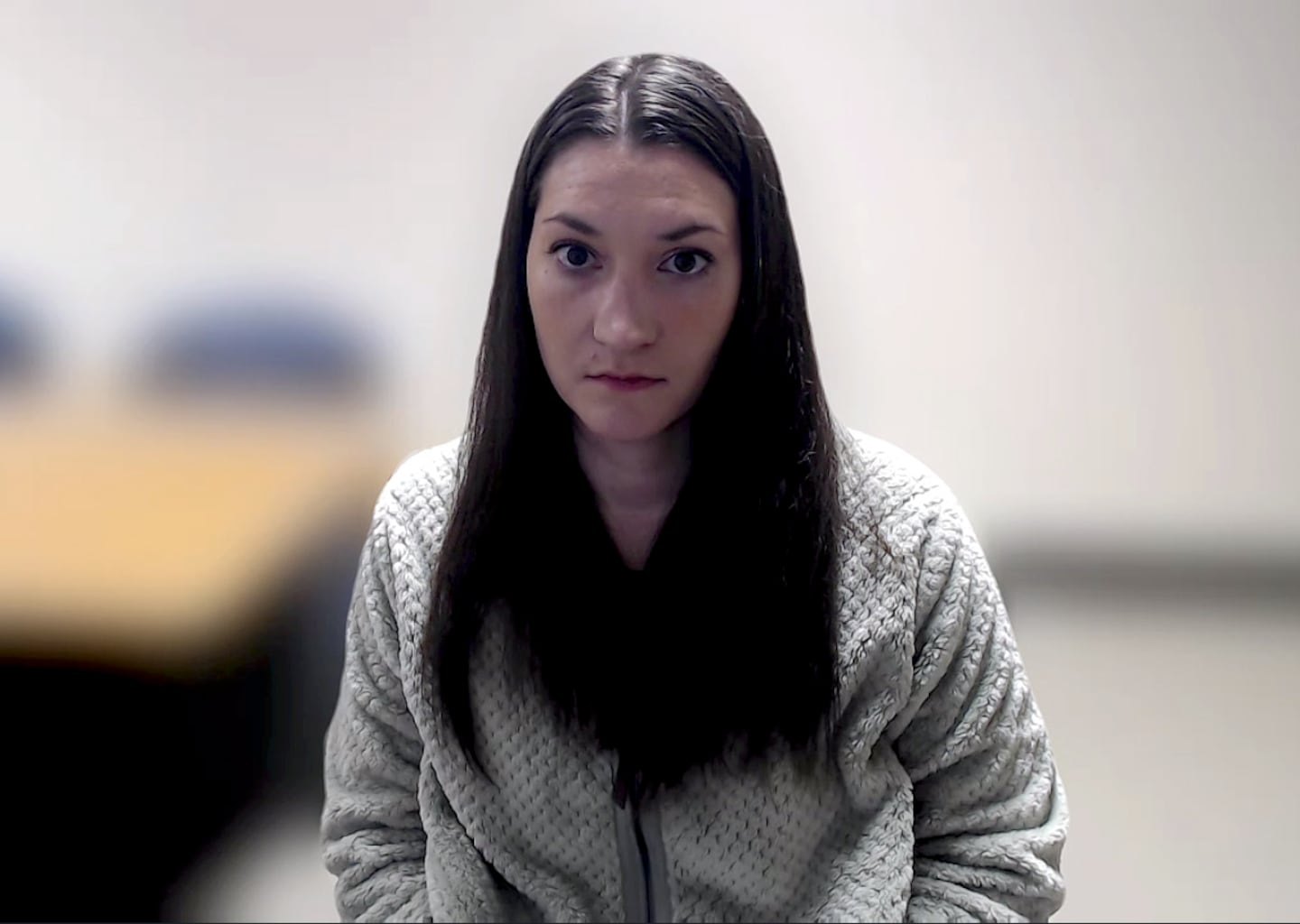
At 2:23 on the afternoon of September 4, a judge in Plymouth, Massachusetts, declared a mistrial in the murder case against Lindsay Clancy. The jury had deliberated for seven days. Judge William Sullivan had just told the lawyers he would not question the one juror the defense said was holding out: “I’m not going to do a further inquiry of this juror,” CBS Boston reported. The defense went to the state’s highest court for an emergency order, and a single justice, Justice Wendlandt, turned it down after about fifteen minutes. Then the jury of nine women and three men was told it was finished. Lindsay Clancy, 36, has pleaded not guilty and has not been convicted. She is charged with murder in the January 2023 deaths of her children Cora, 5, Dawson, 3, and Callan, 8 months.
The jury’s split has since been reported as 11 to 1. That figure comes from the defense and from jurors, not from a court announcement, and the defense says the eleven were ready to find Clancy not criminally responsible by reason of mental illness. A lawyer for the one says he had no doubt about her guilt. The judge who ended the trial has since refused to acquit her, refused to look into the holdout, and set November 2 to hear a motion that says trying her again would violate the Constitution.
The law, as the courts have applied it, makes a second trial more likely than not, and that is not the real story. The real story is what a second jury would be asked to decide, because the first one’s division shows how little the evidence settles. I have not attended any hearing. I am working from court coverage, filings and the Massachusetts Supreme Judicial Court’s published decisions, all linked, and I do not name the holdout juror.
What happened in that courtroom
The trial ran about seven weeks. At trial the defense did not dispute that Clancy killed her children. The question was whether she was criminally responsible. Patrick Clancy left the house at about 5:15 p.m. that evening to buy children’s medicine and pick up takeout. Pharmacy video shows him inside from 5:32 to 5:37 p.m. He was home again at about 6:09 and called 911 at 6:11. Cora and Dawson were pronounced dead that night. Callan died three days later at Boston Children’s Hospital. Clancy was found injured after attempting to take her own life, and she uses a wheelchair.
The defense said postpartum psychosis and bipolar disorder left her unable to understand the wrongfulness of her acts or to control them. Testimony described her hearing a male voice commanding her to kill the children and herself. The experts split. For the defense, Dr. Phil Resnick, a forensic psychiatrist, described a command hallucination that left her unable to conform her conduct, and Dr. Paul Zeizel, a forensic psychologist, described bipolar disorder with postpartum psychosis, WBUR reported. For the prosecution, Dr. Gregory Saathoff, a psychiatrist, doubted the voice and saw planning, and Dr. Kirk Heilbrun, a psychologist, found bipolar disorder but not postpartum psychosis. Prosecutors said Clancy used a map app to work out how long her husband’s errand would take.
Under Massachusetts law the burden sits with the state. The test comes from Commonwealth v. McHoul, and the Commonwealth must prove beyond a reasonable doubt either that the defendant had no mental disease or defect, or that she kept substantial capacity both to appreciate the wrongfulness of her conduct and to conform it to the law, according to the state’s model jury instruction. The defendant does not have to prove she was ill. If the jury finds she was not responsible, she is not freed. She is committed for treatment and reviewed periodically, WBUR explains.

Why a hung jury does not end a case
Is eleven to one not an acquittal? No, and the law on this is old. In Richardson v. United States, in 1984, the US Supreme Court held that a hung jury does not end the original jeopardy, so the state may try the defendant again, even where the evidence at the first trial was thin. In Arizona v. Washington, in 1978, the Court called a deadlocked jury “the classic basis for a proper mistrial” and gave trial judges wide deference in deciding when the deadlock is real. That is why Judge Sullivan’s October 1 ruling matters less to the retrial question than it seems. He refused to find Clancy not guilty, writing that the physical and circumstantial evidence would let a rational jury find the elements of murder proven, the Boston Globe reported, and he added that a jury may give little or no weight to defense experts. That decides only whether the evidence was enough to go to a jury.
The defense is therefore left with one door: that the mistrial lacked “manifest necessity,” the test a judge must meet before ending a trial without the defendant’s consent. In a 34-page motion, lawyer Martin Weinberg argues that after two reports that a juror was refusing to follow the instruction on reasonable doubt, the judge did not question the jurors enough. According to the defense, after the first report he asked the jurors individually whether they could apply the law, and after the second he reminded the jury as a group, Fox News reported. The defense also wanted to put the holdout’s confidential questionnaire and phone records before the court.
On October 21 Sullivan denied that request. The questions about the juror, including his questionnaire answers and phone use, came to light only after the mistrial, he wrote, and so “simply is not relevant” to whether the mistrial was necessary when it was declared, which turns on what was known at the time. Courts also may not examine a juror’s private reasoning, Boston.com reported. He leaned on the Supreme Judicial Court’s decision in the first Karen Read case. The juror’s lawyer says he did not lie and used his phone only on breaks.
What the Read decision tells us
That decision is the best guide to where this is going. In Read v. Commonwealth, decided February 11, 2025, a seven-justice court held that the judge had not abused her discretion in declaring a mistrial after three notes saying the jury was deadlocked. It said that a verdict requires an announcement in open court, so jurors’ later accounts of private agreement “cannot retroactively alter” the outcome, it upheld the denial of a posttrial inquiry into the jury to protect the secrecy of deliberations, and it held that a retrial was not barred. The First Circuit later declined to overturn it on federal habeas review, though it noted the state court’s remark that sharing the jury’s third note with counsel would have been the “more prudent course”. I found no 2026 decision from the Supreme Judicial Court on these questions.
So the defense is asking Sullivan to read Read narrowly, and Sullivan has relied on it. That does not decide the motion. A narrower question remains, whether the judge could have probed the holdout before ending the trial, and that is a judgment call on which a judge’s own decision gets great deference. My own reading, and not a prediction, is that the motion faces a hard road.
Could it have gone differently?
The judge could have questioned the holdout. Many of us would find that uncomfortable, because it risks pressing a lone juror to give way, and it is the very risk the Read court cited when it protected deliberations. But the defense’s point is that a short inquiry before a mistrial is not the same thing as a probe after one, and nobody can now say what it would have shown. The prosecution could have told the court what it planned to do. Instead, District Attorney Timothy Cruz has said only that his office is doing “a very thorough review,” CBS Boston reported, and I found no decision. Clancy’s lawyer Kevin Reddington has said he cannot be ready for a retrial before June. A family waiting for a decision, and a defendant held in a psychiatric hospital, both wait on the same person.
The defense, for its part, argued on September 29 that prosecutors never proved Clancy killed the children, a prosecutor called that “laughable”, and CNN noted that it appeared to contradict the trial defense, which argued not responsibility rather than denying the killings. A defense that shifts between those positions makes a second jury’s job harder, and a second jury starts from a record in which the first could not agree.
There is also the question the criminal case cannot ask. Lindsay and Patrick Clancy have each filed civil suits against her medical providers, alleging that they over-medicated her and missed signs of a psychiatric emergency. The providers have largely declined to comment, and those are allegations, not findings. Postpartum psychosis is rare, affecting 1 to 2 in 1,000 births, and it involves a break from reality such as hallucinations or delusions. Postpartum depression is far more common, with estimates from about 1 in 8 to 1 in 5 mothers, and it typically does not involve that break. Whether a woman in that break was seen in time is a question the civil suits may test and the criminal case will not.
The best case for a second trial
The strongest objection is that a retrial is the system working, not failing. A hung jury is not an acquittal. Three children died. The one juror who held out says he had no doubt, and prosecutors, who oppose any inquiry into him, are entitled to put the case to twelve people again. That is a serious argument. I would only add that “the system works” has to include the cost. Patrick Clancy, who has since divorced his wife and has said he forgave her, said through his lawyer after the mistrial that another trial would be “extraordinarily painful” and that there will never be closure. That is his statement, and I found nothing from him or the family since September.
What I do not know
I do not know whether Cruz will retry her, or on what charge. I do not know how Sullivan will rule on November 2, when he is due to hear the double jeopardy motion, a motion to investigate the juror, and the prosecution’s request to limit lawyers’ public statements, which the prosecution filed on September 28 and which WBZ and Boston Globe Media Partners oppose. NBC Boston reports that no new evidence will be introduced at that hearing. I also do not know the real vote count or the text of the jury’s notes, because I found no official record of either. Sources differ on how many witnesses testified. I could not read the defense motion itself.
On the day the trial ended, the jury was sent home, the lawyers went to the corridor, and the judge went on with his afternoon. On November 2 he will hear whether the case can start again. Whatever he decides, the question the first jury could not answer, whether a mother in a break from reality could be held to what she did, is still open.
If you or someone you know is struggling after childbirth or having thoughts of suicide, call or text 988 in the United States, or the National Maternal Mental Health Hotline at 1-833-852-6262.
Comments
Every comment is read by a person before it appears, so yours will not show straight away. We publish comments that are civil and on the subject. To report a mistake in the piece, use the corrections page, so it is fixed in the piece itself.